An Okinawa Prefecture Map has to explain a prefecture that cannot be understood as one continuous landmass. Okinawa’s municipalities extend from the northern end of the main island through the Kerama and Daito islands to the Miyako and Yaeyama groups far to the southwest. The supplied maps place these separated areas on one page through a main-island view and carefully arranged inset areas.
The collection contains three matching views: a color administrative map with English labels, a black-and-white labeled map, and an unlabeled outline map. All three show the same island and municipal framework, so readers can move from reference work to worksheet or design use without changing the underlying geography. The downloadable files are JPG images prepared for A3 use.
This Okinawa Prefecture Map set is intended for teachers, students, presentation makers, bloggers, and designers who need more detail than a locator map of Japan. It can help explain where Naha sits on the southern part of Okinawa Island, how Nago relates to the less densely divided north, and why Miyakojima, Ishigaki, Taketomi, and Yonaguni require a separate viewing area. The layout is a regional reference rather than a navigation chart, and the inset arrangement should not be used to measure sailing distances or direct travel routes.
Table of Contents
Okinawa Prefecture Map Overview
Okinawa Prefecture forms Japan’s southernmost prefectural chain, extending between the East China Sea and the Pacific Ocean. Its administrative capital, Naha, is on Okinawa Island, often called the main island. That island carries the most tightly packed pattern of municipal boundaries, particularly around Naha and the central urban corridor, while the northern area is divided into larger city and village territories.
The map makes several geographic groupings easier to read. Iheya and Izena appear north of the main island; Ie lies offshore from the Motobu Peninsula; Kumejima, Aguni, Tonaki, Zamami, and Tokashiki occupy separate positions to the west and southwest. Farther away, the upper-left inset gathers Yonaguni, Taketomi, Ishigaki, Tarama, and Miyakojima, while a smaller box isolates Minami Daito. These are layout devices that keep small islands visible on an A3 page.
On the main island, labels also reveal a clear north-to-south change in scale. Kunigami, Ogimi, Higashi, and Nago occupy broad northern shapes. Around Okinawa City, Urasoe, Ginowan, Nishihara, and the communities surrounding Naha, the boundaries become shorter and the labels more crowded. The Okinawa Prefecture Map also names Nago Bay, Kinbu Bay, and Nakagusuku Bay for orientation without turning the sheet into a physical or road map.
Included Map Versions
The Okinawa Prefecture Map archive provides three JPG versions built from the same administrative drawing. The color file is the quickest reference when neighboring municipalities must be distinguished. The black-and-white file retains names and lines for monochrome documents. The outline file removes text and color but keeps the municipal framework, leaving room for original labels, symbols, or thematic shading.
- Color map with municipality names, boundary separation, island insets, and selected bay labels
- Black-and-white map with the same English labels and administrative geometry
- Blank outline map with municipal boundaries but no place labels
- JPG image files arranged for A3 printing and large-page placement
Because the outer islands are repositioned into inset areas, all versions should be read as administrative reference graphics rather than continuous scale maps. That distinction matters when adding ferry lines, flight paths, or distance annotations. Use a separate geographic source for those tasks rather than relying on the spacing shown between the inset boxes.
Color Okinawa Map with Municipal Boundaries
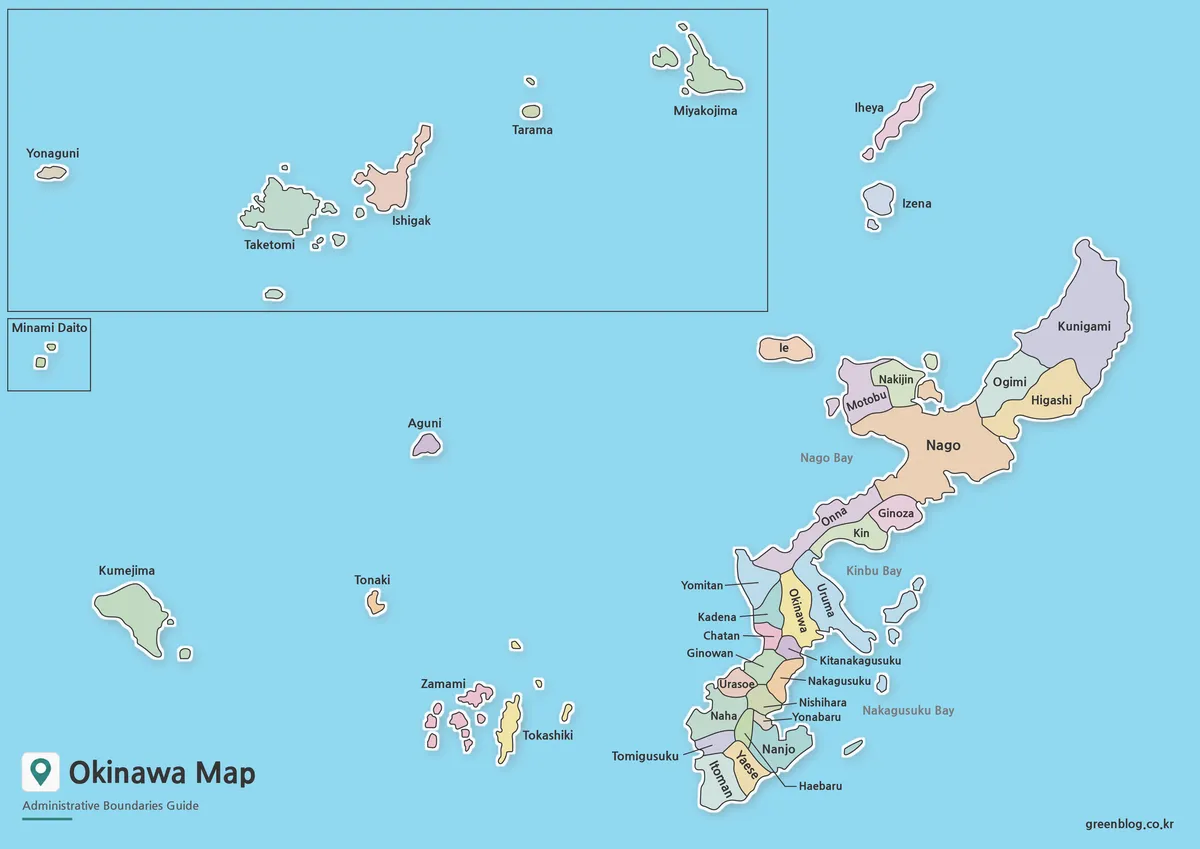
The color Okinawa Prefecture Map separates adjacent municipal areas with muted contrasting fills while retaining a blue sea background. This is particularly effective in the narrow southern half of the main island, where Naha, Urasoe, Ginowan, Tomigusuku, Nanjo, and several towns and villages meet within a limited area. Leader lines help connect some small or compact shapes to their names.
Color also helps a presenter move between island groups without losing the administrative subject. Ishigaki and Taketomi can be compared inside the southwest inset, while Miyakojima and Tarama remain distinct farther east within the same framed area. For classroom projection or a regional overview slide, the fills allow an audience to follow a spoken explanation more quickly than boundary lines alone.
Black and White Printable Version
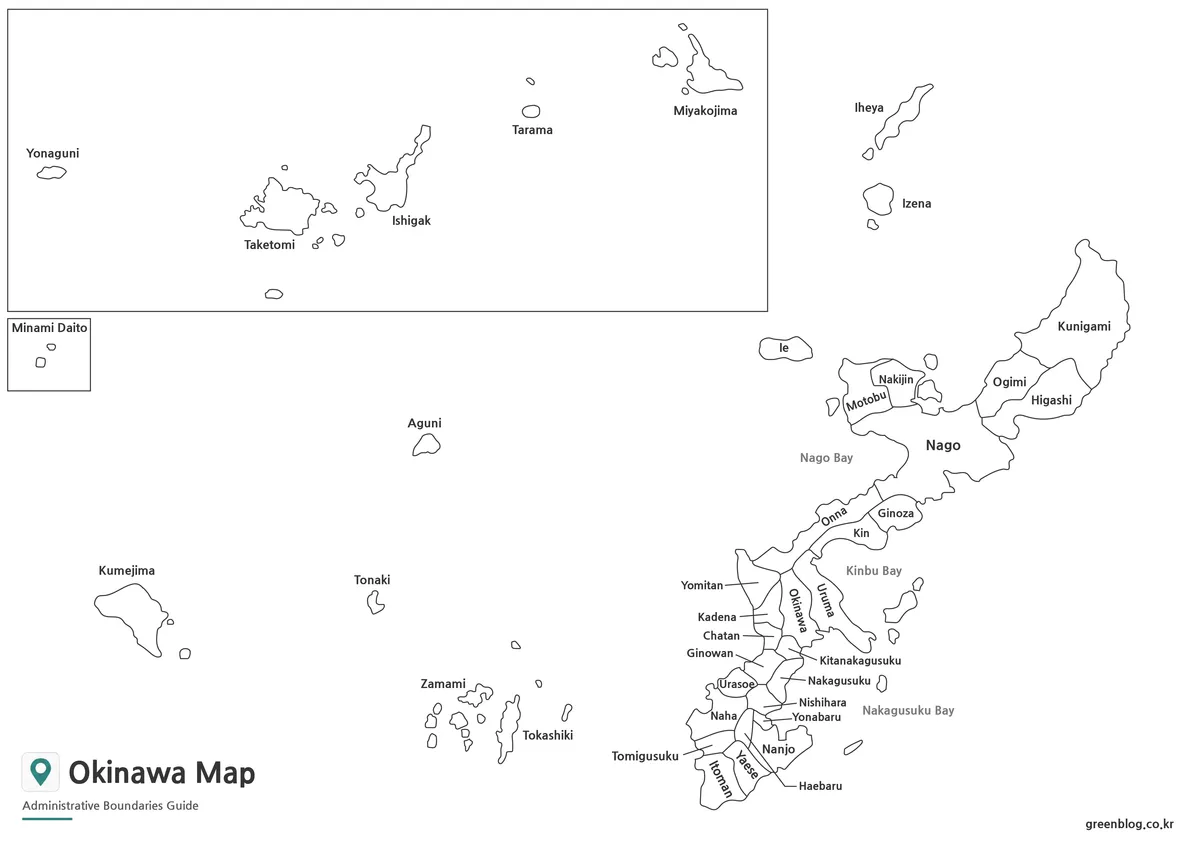
The monochrome version removes fill colors but preserves municipal names, coastal outlines, boundary lines, inset frames, and bay labels. It fits reports and handouts in which colored areas would compete with surrounding text or charts. The white background also makes the island silhouettes easy to place beside notes about Japan’s prefectures.
Label density is not uniform across the page. Northern names have room to sit inside larger polygons, whereas the Naha–Okinawa City corridor relies on tighter placement and several leader lines. Printing the Okinawa Prefecture Map at the intended large-page size protects that distinction. When reducing it for a smaller sheet, check the southern labels first, since they will reach the readability limit before the larger northern and outer-island names.
Blank Outline Map for Editing
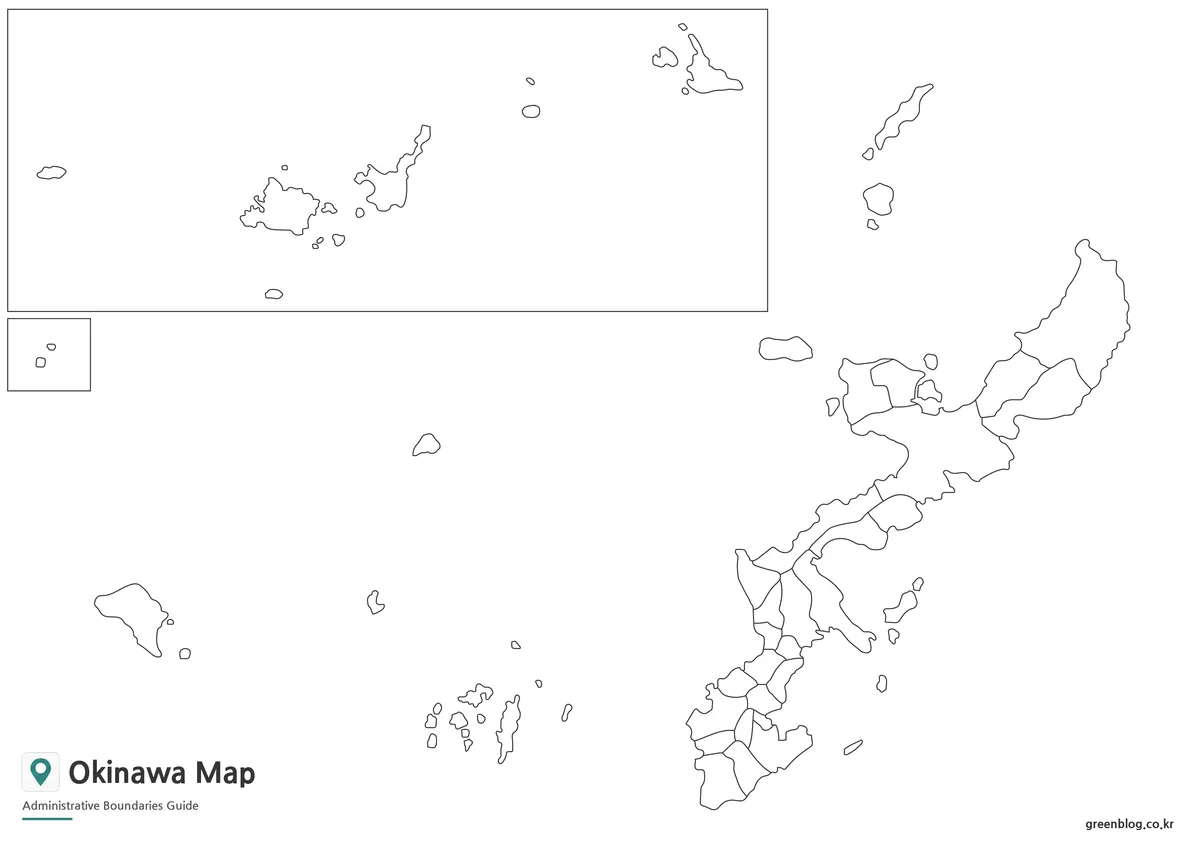
The outline map keeps the complete boundary drawing and inset composition while removing all municipality and bay names. Students can label Naha, Nago, Okinawa City, Miyakojima, Ishigaki, and Yonaguni, then compare their answers with either labeled version. A teacher can also assign different colors to the main island, Kerama Islands, Daito Islands, Miyako Islands, and Yaeyama Islands as a regional-grouping exercise.
For design work, the empty polygons provide space for categories rather than labels. A project could shade municipalities by a supplied statistic, mark selected ports or airports, or trace a conceptual travel sequence across several islands. Since the downloadable map is a raster JPG rather than a vector source, edits should be made on a duplicate and at the largest available size to avoid unnecessary loss of line clarity.
Practical Uses for the Map
Choosing among the files depends on whether the reader needs recognition, economical document styling, or an annotation base. Use the color file when an audience must distinguish neighboring municipalities at a glance. Choose black and white when the names are the main reference and the map will sit within a monochrome report. Start with the outline when learners or designers need to supply their own information.
An Okinawa Prefecture Map is especially valuable for assignments that compare compact southern municipalities with the larger northern territories, or the main island with remote groups such as Miyako and Yaeyama. In a presentation, reveal the labeled map after an outline-based question. In a worksheet, ask learners to locate the prefectural capital and identify which municipalities appear outside the main-island drawing. In an infographic, keep the inset frames visible so readers understand that the separated islands belong to one prefecture.
For printing, preserve the image proportions and avoid cropping the upper-left and lower-left boxes; doing so would remove much of the southwest chain or the Minami Daito inset. A3 gives the densest southern labels more room, but a reduced print can still serve as a general outline if those names are not essential. The files do not show roads, terrain, ferry routes, or attractions, so pair them with a specialized source when a project requires those layers.
Frequently Asked Questions
Does this Okinawa Prefecture Map include municipal boundaries?
Yes. The map versions are designed around Okinawa’s municipal and administrative boundary structure.
Can I print the map in A3 size?
Yes. The map was prepared for high-resolution A3 printing.
Is there a blank version for editing?
Yes. The outline map is suitable for editing, coloring, labeling, and infographic work.
Which version is best for classroom use?
The black and white map works well for printing, while the outline map is useful for worksheets and student activities.
Map File Information
Download three matching Okinawa administrative map images for labeled reference, monochrome documents, or custom annotation.
- Included Versions: Color map / Black and white labeled map / Blank outline map
- Printable Size: A3
- File Type: JPG
- Intended Use: Printing · Classroom study · Presentations · Annotation
Additional Resources
- Visit Okinawa Japan — The official tourism guide introduces the prefecture’s main island and remote island groups for further regional context.
Related Maps
Green Map creates custom-edited map images using open geographic data sources such as geoBoundaries, Natural Earth, OpenStreetMap, and government open data.
These maps are edited visual materials, not raw data files, and are provided for education, documents, presentations, and graphic reference.