The month in which the tertiary academic year ends differs substantially across education systems. UNESCO Institute for Statistics (UIS) indicator 10404 provides 106 country and area observations for 2024. July is the most common end month with 26 observations, while June and December each appear in 24. Those three months alone account for 74 observations, or 69.8% of the dataset.
A value of 7 is a calendar category—July—not a score and not a seven-month academic year. A value of 12 means December. The indicator records only the end month of the academic school year. It does not show the exact last teaching day, examination dates, commencement ceremonies, vacation dates, or the number of semesters.
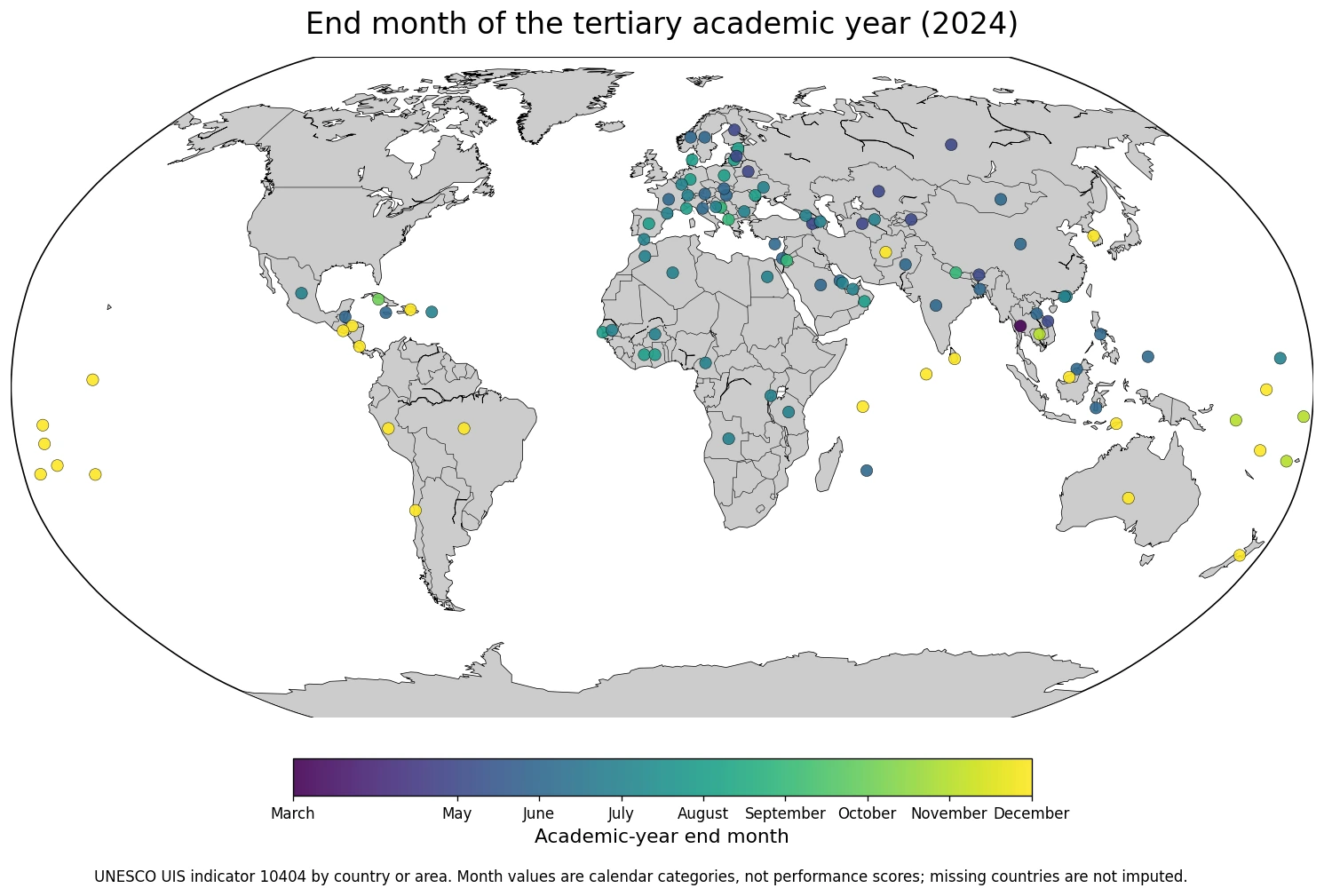
Table of Contents
July is most common, followed closely by June and December
July appears in 26 observations. June and December each appear in 24. June and July together account for 50 countries and areas, or 47.2% of the sample. Broadening the window from May through August captures 72 observations, equal to 67.9%.
August appears in 12 observations and May in 10. September and November each appear in four. March and October appear only once each, and no 2024 observation in this extract ends in January, February, or April. The distribution is therefore concentrated in a few months without having one universal global calendar.
| Academic-year end month | Countries or areas | Share of 106 observations |
|---|---|---|
| March | 1 | 0.9% |
| May | 10 | 9.4% |
| June | 24 | 22.6% |
| July | 26 | 24.5% |
| August | 12 | 11.3% |
| September | 4 | 3.8% |
| October | 1 | 0.9% |
| November | 4 | 3.8% |
| December | 24 | 22.6% |
June and July endings span Europe, Asia, the Middle East, and Africa
The June group includes Austria, France, Sweden, Norway, China, India, Indonesia, the Philippines, Saudi Arabia, and Pakistan. The July group includes Switzerland, Bulgaria, Serbia, Ukraine, the United Arab Emirates, Qatar, Egypt, Morocco, Algeria, Mexico, and Uzbekistan.
The same month therefore crosses regional boundaries, and countries within one region can still differ by a month or more. The map is useful for seeing those broad calendar alignments, but it should not be read as proof that universities inside every country follow an identical institutional calendar.
December is just as common as June
December is reported by 24 countries and areas, exactly the same count as June. The group includes Australia, New Zealand, Brazil, Chile, Costa Rica, Peru, Sri Lanka, Malaysia, Maldives, Timor-Leste, Tonga, Samoa, and Vanuatu. The Republic of Korea is also reported with a December end month in the 2024 data.
The strong December cluster should not be explained by hemisphere alone. Several Southern Hemisphere and Pacific systems are present, but the group also includes countries in Asia, Central America, and other regions. Academic calendars can reflect institutional history, semester organization, examinations, and national education structures, none of which is directly measured by this month-only indicator.
May endings are concentrated partly in Eurasia and Northern Europe
May appears in 10 observations. Armenia, Belarus, Kazakhstan, Kyrgyzstan, the Russian Federation, and Turkmenistan form a substantial Eurasian cluster, while Finland and Latvia are also in the May group. Bhutan and Viet Nam complete the set.
A May end month does not imply a shorter academic year. Without the start month or exact start date, duration cannot be calculated. Two systems can both finish in May but begin at very different points in the preceding calendar year.
March and October are the rarest reported end months
Thailand is the only March observation and Cuba the only October observation in the 106-row 2024 extract. September is reported for Albania, Bosnia and Herzegovina, Jordan, and Nepal, while November is reported for Fiji, Cambodia, the Solomon Islands, and Tuvalu.
Rare values are noteworthy for calendar comparison, but they should not be labelled abnormal. Education systems organize academic years in different ways, and indicator 10404 is descriptive. It identifies the reported end month rather than judging whether one calendar is preferable.
End month is not the same as academic-year duration
Finishing in July does not mean the academic year lasts seven months, and finishing in December does not prove that the year is longer than in a June-ending system. Duration requires a start date plus information about breaks and the structure of teaching periods.
The end-month indicator is most useful as calendar infrastructure. It can help frame questions about international student mobility, exchange timing, admissions, graduation cycles, or scholarship schedules by showing when a country’s tertiary academic year broadly reaches its end.
A national observation may differ from an individual university calendar
UIS provides country-level information for international comparison. Within one country, universities can still have different term systems, examination periods, professional-programme calendars, or summer sessions. Medical schools, teacher-training institutions, and other programmes can also follow specialized schedules.
For actual study-abroad or exchange planning, the country-level month should therefore be treated as an orientation point. The official academic calendar of the specific institution remains the authoritative source for registration deadlines, final examinations, breaks, and graduation events.
Why the end month matters for international admissions and mobility
Different academic-year endings can create gaps between graduation and the start of a new programme abroad. A student finishing in June may be able to move directly into a September intake, while a December-ending system can align differently with admissions cycles in countries that begin their next academic year earlier.
The end month still cannot determine eligibility or actual transition timing on its own. Degree conferral, transcript release, visa processing, application deadlines, and institution-specific semester dates can all occur on different schedules. The country indicator is best used to identify structural calendar mismatch before checking the detailed institutional requirements.
Summer terms and multiple intakes can extend activity beyond the reported end month
A national end-month observation summarizes the regular academic school year, but some institutions operate summer terms, intensive sessions, or multiple entry cycles. Teaching and examinations can therefore continue after the month used in the national comparison.
Researchers and students should keep the level of analysis clear. Country data reveal broad system structure, while university calendars provide the operational details needed for individual planning. Using both levels together is more informative than treating the national month as a universal deadline.
The numerical mean of month codes is not especially informative
The arithmetic mean of the month numbers is 8.05 and the median is month 7. Because the calendar is cyclical—December is followed by January—the mean month should not be overinterpreted as a typical finishing date. A frequency distribution is more transparent.
There are 9 distinct observed end months, and 74 of the 106 observations are concentrated in June, July, or December. The map’s numeric scale is therefore only a way to distinguish calendar categories; a higher month number does not represent a better, later, or longer education system.
All 106 observations use the same 2024 reference year
Every row in the supplied dataset is dated 2024, avoiding the mixed-year problem that affects many latest-available international education comparisons. Coverage is still incomplete, however. A country without a row is not assigned a guessed end month.
Small islands and separately reported areas remain in the statistical sample and are shown as point locations where possible. This preserves the full 106-row comparison while avoiding the false assumption that an unreported country should be coded as January, zero, or any other month.
What this indicator cannot tell us
The end month alone does not measure teaching days, vacation length, examination intensity, completion, education quality, student satisfaction, tuition, or learning outcomes. Two systems with the same July end month can start in different months and have very different semester structures.
For that reason, the indicator should not be turned into a performance ranking. It is a structural calendar variable. Questions about educational outcomes need separate measures such as completion, enrolment, attainment, learning results, student mobility, or finance.
Data scope and source
The analysis uses 106 country and area observations from the UNESCO Institute for Statistics official API indicator 10404 for 2024. The official metric is ‘End month of the academic school year (tertiary education)’, with the published values interpreted as calendar month numbers.
The exact distribution is July 26, June 24, December 24, August 12, May 10, September 4, November 4, and one each in March and October. All counts and the map are calculated directly from those published 2024 values.
The main takeaway
July is the most common 2024 end month for the tertiary academic year in this dataset, appearing in 26 of 106 observations. June and December each appear in 24, so the three dominant months account for 69.8% of the sample. The indicator is calendar structure, not educational performance or academic-year length, and institution-level calendars can differ from the national observation.
Frequently Asked Questions
What does a value of 7 mean in this indicator?
It means July, the seventh calendar month. It is not a score or a measure of academic-year duration.
What is the most common tertiary academic-year end month in 2024?
July is most common with 26 observations, followed by June and December with 24 each.
Does the national end month match every university’s calendar?
Not necessarily. Universities, programmes, examination periods, summer sessions, and graduation schedules can differ within the same country.
Related Articles
Green Map creates custom-edited map images using open geographic data sources such as geoBoundaries, Natural Earth, OpenStreetMap, and government open data.
These maps are edited visual materials, not raw data files, and are provided for education, documents, presentations, and graphic reference.