The gender composition of internationally mobile tertiary students from North America differs substantially across destination countries. UNESCO Institute for Statistics indicator E.5T8.FOREIGN.ORG21000913.GPIA reports the adjusted gender parity index (GPIA) for inbound mobile tertiary students whose origin is North America.
Among the 76 destination-country observations dated 2023, 5 fall in the 0.97–1.03 parity band. 45 are above 1.03 and therefore female-leaning, while 26 are below 0.97 and male-leaning. The Republic of Korea records 1.281, placing it on the female-leaning side.
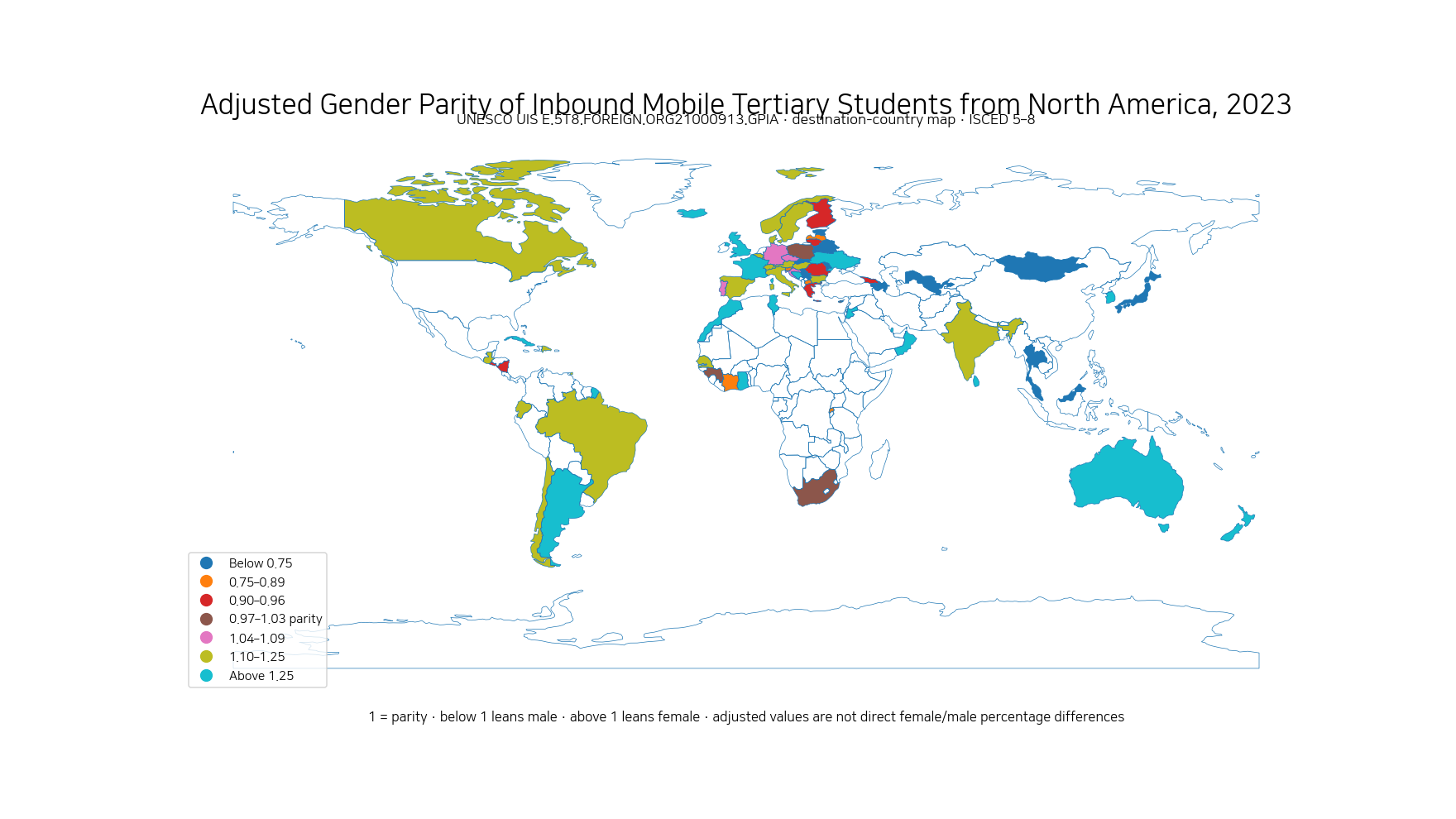
Table of Contents
The mapped countries are destinations, not origins
The directional structure is essential. North America is fixed as the region of origin. Each row and map polygon represents a destination country or area where North American-origin students are enrolled in tertiary education.
Korea’s value therefore describes the gender balance among North American-origin mobile tertiary students studying in Korea. It does not describe Korean students who went to North America.
Internationally mobile students are not simply all foreign citizens
UIS defines internationally mobile students as people who physically cross an international border to participate in education in a destination country different from their country of origin. For tertiary students, country of prior upper-secondary education is the preferred origin concept, with usual residence used when needed and citizenship only as a last resort.
This differs from a simple foreign-student measure based only on citizenship. A student can be a citizen of the destination country and still be internationally mobile if the relevant prior education and cross-border movement criteria are met.
GPIA is centered on 1
The gender parity index compares female and male indicator values. UIS uses an adjusted version that is symmetric around 1 and bounded between 0 and 2.
A value of 1 indicates parity. Values below 1 indicate a male-leaning result, while values above 1 indicate a female-leaning result. The UIS SDG guidance uses 0.97–1.03 as a practical parity band.
A GPIA of 1.28 does not mean 28% more women
Adjusted parity values are not the raw female-to-male ratio once the original ratio exceeds 1. UIS transforms ratios above 1 so that the measure remains symmetric around parity.
For that reason, Korea’s 1.281 should not be translated directly into a statement that female students outnumber male students by 28.1%. The index supports direction and distance-from-parity interpretation; exact sex counts require the underlying female and male student numbers.
Only five destinations fall inside the 0.97–1.03 parity band
5 of the 76 observations fall within 0.97–1.03. Guinea and Cyprus are exactly 1.000, Poland is 0.998, South Africa 0.987 and Hong Kong SAR 1.013.
Those values indicate similar female and male indicator values, but they say nothing about the total number of North American-origin students. A small destination and a very large destination can both have a parity index close to 1.
| Destination | ISO3 | GPIA | Interpretation |
|---|---|---|---|
| Cyprus | CYP | 1.000 | Parity band |
| Guinea | GIN | 1.000 | Parity band |
| Poland | POL | 0.998 | Parity band |
| South Africa | ZAF | 0.987 | Parity band |
| Hong Kong SAR, China | HKG | 1.013 | Parity band |
| Georgia | GEO | 0.948 | Male-leaning |
| Greece | GRC | 0.941 | Male-leaning |
| Portugal | PRT | 1.061 | Female-leaning |
| Finland | FIN | 0.925 | Male-leaning |
| Croatia | HRV | 1.076 | Female-leaning |
Korea is 1.281 and therefore female-leaning
The Republic of Korea records 1.281, above the 1.03 parity threshold. Australia is 1.277, Spain 1.233, Italy 1.241, India 1.210 and Brazil 1.209; each is also on the female-leaning side.
Canada is 1.154 and Germany 1.098, also above parity. Japan is 0.659, making its North American-origin mobile-student composition distinctly male-leaning in this 2023 observation.
| Destination | GPIA | Direction |
|---|---|---|
| Republic of Korea | 1.281 | Female-leaning |
| France | 1.552 | Female-leaning |
| United Kingdom | 1.484 | Female-leaning |
| Australia | 1.277 | Female-leaning |
| Canada | 1.154 | Female-leaning |
| Germany | 1.098 | Female-leaning |
| Japan | 0.659 | Male-leaning |
| India | 1.210 | Female-leaning |
| Brazil | 1.209 | Female-leaning |
| Spain | 1.233 | Female-leaning |
| Italy | 1.241 | Female-leaning |
| South Africa | 0.987 | Parity band |
France and the United Kingdom have especially high female-leaning indices
France records 1.552 and the United Kingdom 1.484. Tunisia and Saint Lucia are reported at 2.000, while Cuba and Monaco are 1.455 and Ukraine 1.439.
A high GPIA is not a score for successful international-student recruitment. It describes the direction of the gender composition only. The index does not reveal total student volume, study field, scholarship use, visa rules or the distribution of origin countries within North America.
| Strong female-leaning destinations | ISO3 | GPIA |
|---|---|---|
| Tunisia | TUN | 2.000 |
| Saint Lucia | LCA | 2.000 |
| France | FRA | 1.552 |
| United Kingdom | GBR | 1.484 |
| Cuba | CUB | 1.455 |
| Monaco | MCO | 1.455 |
| Ukraine | UKR | 1.439 |
| Sri Lanka | LKA | 1.429 |
| Bosnia and Herzegovina | BIH | 1.429 |
| New Zealand | NZL | 1.413 |
| Ghana | GHA | 1.378 |
| Iceland | ISL | 1.363 |
Mongolia, Bermuda, Thailand and Japan are strongly male-leaning
Mongolia has the lowest value at 0.250. Bermuda is 0.333, Thailand 0.406, Armenia 0.512, Uzbekistan 0.529, Moldova 0.564 and Azerbaijan 0.571.
Japan’s 0.659 is also well below parity. As with high values, a low GPIA should not be interpreted as weak recruitment or poor education quality. It only identifies the direction of gender imbalance among the North American-origin mobile students observed in that destination.
| Strong male-leaning destinations | ISO3 | GPIA |
|---|---|---|
| Mongolia | MNG | 0.250 |
| Bermuda | BMU | 0.333 |
| Thailand | THA | 0.406 |
| Armenia | ARM | 0.512 |
| Uzbekistan | UZB | 0.529 |
| Republic of Moldova | MDA | 0.564 |
| Azerbaijan | AZE | 0.571 |
| Malaysia | MYS | 0.611 |
| Belarus | BLR | 0.636 |
| Japan | JPN | 0.659 |
| Slovakia | SVK | 0.680 |
| Serbia | SRB | 0.692 |
Extreme values need student counts for context
Values such as 2.000 or 0.250 look dramatic, but the dataset does not include the total number of North American-origin students in each destination. Parity indices can move sharply when the underlying student population is small.
The safest interpretation is therefore to treat extreme GPIA values as signals for follow-up. Female and male headcounts and multiple years of data are needed before describing the imbalance as a stable structural pattern.
Regional medians still hide large within-region differences
Among mapped observations, the median GPIA is about 1.098 in Europe, 0.974 in Asia and 1.087 in Africa.
The within-region spread is substantial. France and the United Kingdom are strongly female-leaning, while Estonia, Latvia and Slovakia are male-leaning. In Asia, Korea and India lean female while Japan, Thailand and Malaysia lean male. Regional averages are therefore not sufficient explanations.
This indicator does not measure destination popularity
GPIA measures gender balance, not the number of students choosing a destination. A country can have a parity index close to 1 with very few students, or a strongly skewed index with a large student population.
Questions about which destinations receive the most North American-origin students require inbound student counts. Questions about the share of all international students coming from North America require a different denominator again.
Blank map areas do not mean zero
The source table contains 76 destination observations, of which 70 match separate polygons in the low-resolution world boundary layer used here. Small territories such as Bermuda can have valid statistics without a distinct visible polygon at this map resolution.
Countries without a 2023 observation remain unclassified. Missing GPIA values are never replaced with zero because zero would imply an extreme male-leaning result rather than missing data.
Data source and interpretation
Destination values come from the UNESCO UIS Data Browser for E.5T8.FOREIGN.ORG21000913.GPIA, using the 2023 observations. The mobile-student concept follows the UIS internationally mobile students definition.
The GPIA calculation and interpretation follow the UIS parity-index methodology. The source package’s internal provider tag named the World Bank, but the official indicator and dataset are UNESCO UIS, so the completed metadata corrects the provider to UNESCO UIS.
Frequently Asked Questions
What does Korea’s GPIA of 1.281 mean?
It means the gender composition of North American-origin mobile tertiary students in Korea leans female. Because GPIA is adjusted, it does not mean women are exactly 28.1% more numerous.
What does a GPIA of 1 mean?
It indicates gender parity. UIS uses 0.97–1.03 as a practical parity band.
Are the mapped countries student origins?
No. North America is the fixed origin region. The mapped countries are destinations where North American-origin mobile tertiary students study.
Does a higher GPIA mean a destination attracts more international students?
No. GPIA describes gender balance only and does not measure the total volume of mobile students.
Related Maps
Green Map creates custom-edited map images using open geographic data sources such as geoBoundaries, Natural Earth, OpenStreetMap, and government open data.
These maps are edited visual materials, not raw data files, and are provided for education, documents, presentations, and graphic reference.