How similar are girls’ and boys’ shares of lower-secondary students enrolled in general programmes? UNESCO Institute for Statistics (UIS) data for 2024 show that 95 of the 101 available country and territory observations fall inside the commonly used 0.97–1.03 adjusted gender parity band. 70 observations are exactly 1.00000. Mexico is the only value below 0.97, while Cuba, Algeria, Curaçao, Lebanon, and Australia are above 1.03.
This is not an enrolment-rate indicator showing what percentage of girls or boys attend lower secondary school. The underlying measure first asks what share of each sex’s lower-secondary students is enrolled in general programmes, and the GPIA then compares the female and male shares. A value near 1 therefore indicates similar programme-orientation shares for girls and boys.
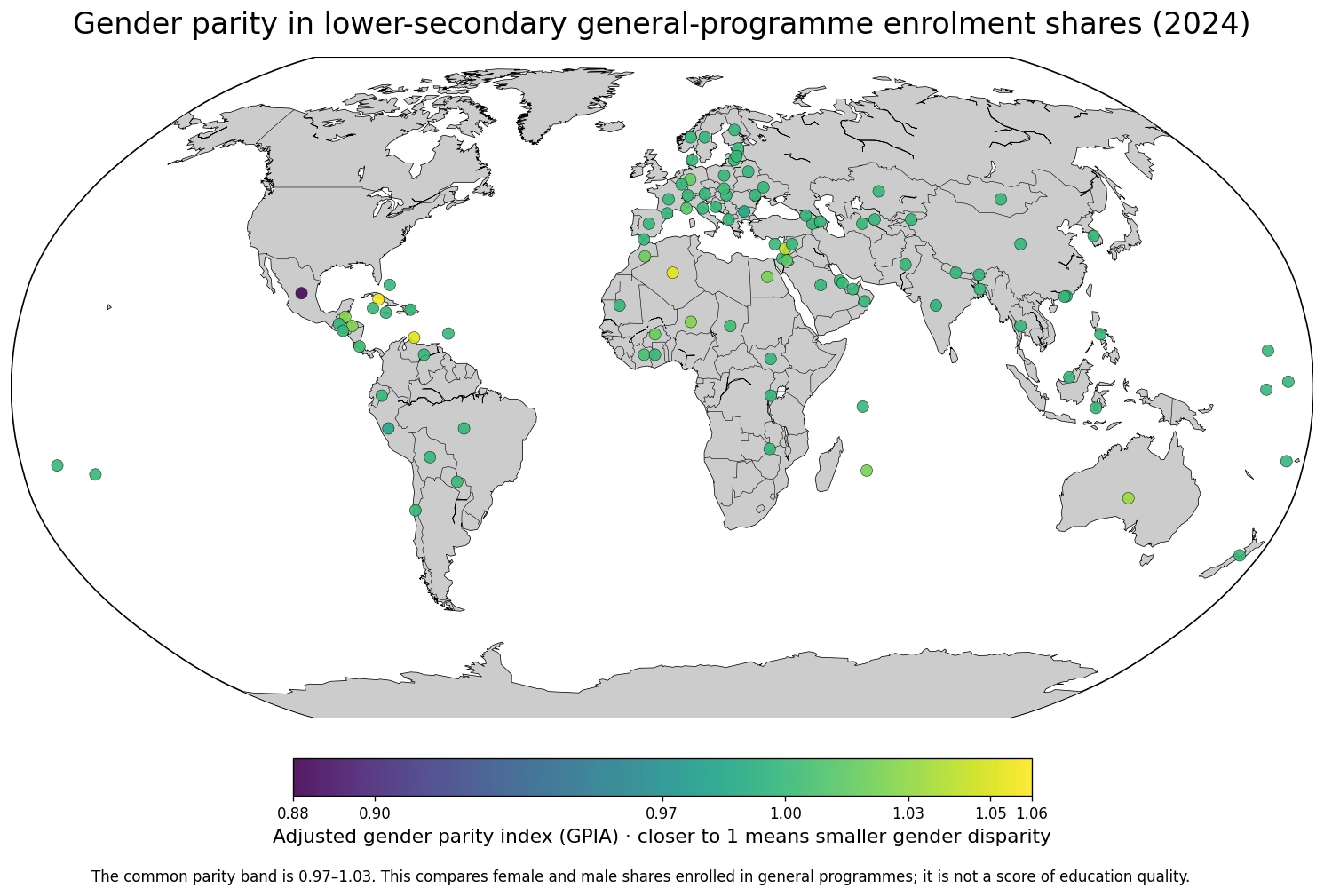
Table of Contents
Ninety-five of 101 observations are inside the parity band
The distribution is exceptionally concentrated around 1. Of the 101 observations, 95, or 94.1%, fall between 0.97 and 1.03. The median and first quartile are both exactly 1.00000, while the third quartile is only 1.00017. For the available 2024 data, gender differences in the share enrolled in general lower-secondary programmes are therefore small in most countries.
The unweighted mean is 1.00316, also very close to 1. An average alone is not enough, however, because a low outlier in one direction and several higher observations in the opposite direction can partly offset each other. The parity-band counts and the outlying cases are more informative than the mean by itself.
| GPIA band | Countries or territories | Share of observations |
|---|---|---|
| Below 0.90 | 1 | 1.0% |
| 0.90–0.969 | 0 | 0.0% |
| 0.97–1.03 parity band | 95 | 94.1% |
| Above 1.03–1.05 | 2 | 2.0% |
| Above 1.05 | 3 | 3.0% |
Mexico is the only observation below 0.97
Mexico is lowest at 0.88446. Bulgaria follows at 0.98545, Peru at 0.98733, India at 0.99600, and Brazil at 0.99885. Bulgaria and Peru are below 1 but remain inside the usual 0.97–1.03 parity band.
| Low-end order | Country or territory | 2024 GPIA |
|---|---|---|
| 1 | Mexico | 0.88446 |
| 2 | Bulgaria | 0.98545 |
| 3 | Peru | 0.98733 |
| 4 | India | 0.99600 |
| 5 | Brazil | 0.99885 |
| 6 | Azerbaijan | 1.00000 |
| 7 | Austria | 1.00000 |
| 8 | Albania | 1.00000 |
| 9 | Bahamas | 1.00000 |
| 10 | Belarus | 1.00000 |
| 11 | Bahrain | 1.00000 |
| 12 | Bangladesh | 1.00000 |
| 13 | Bolivia (Plurinational State of) | 1.00000 |
| 14 | Switzerland | 1.00000 |
| 15 | United Arab Emirates | 1.00000 |
Mexico’s value below 1 indicates that the female share of lower-secondary students in general programmes is lower than the male share. It does not mean that 88.446% of girls are in general programmes. The number is a parity index comparing two underlying sex-specific percentages.
Cuba, Algeria, and Curaçao exceed 1.05
Cuba is highest at 1.05759, followed by Algeria at 1.05246 and Curaçao at 1.05224. Lebanon records 1.04104 and Australia 1.03313, placing five observations above the 1.03 upper boundary. Belize, Niger, Honduras, and Mauritius are above 1 but remain inside the parity band.
| High-end order | Country or territory | 2024 GPIA |
|---|---|---|
| 1 | Cuba | 1.05759 |
| 2 | Algeria | 1.05246 |
| 3 | Curaçao | 1.05224 |
| 4 | Lebanon | 1.04104 |
| 5 | Australia | 1.03313 |
| 6 | Belize | 1.02730 |
| 7 | Niger | 1.02597 |
| 8 | Honduras | 1.02496 |
| 9 | Mauritius | 1.02324 |
| 10 | Egypt | 1.02277 |
| 11 | Morocco | 1.01928 |
| 12 | Burkina Faso | 1.01792 |
| 13 | Germany | 1.01666 |
| 14 | Jordan | 1.01487 |
| 15 | Monaco | 1.01292 |
The UIS adjusted parity methodology transforms values above 1 so disparities can be compared more symmetrically around the parity point. Cuba’s 1.05759 should therefore not be translated into a simple claim that the female share is exactly 5.759% higher. Direction and distance from 1 are the safer interpretation.
General and vocational programmes serve different purposes
The UNESCO-UIS ISCED 2011 operational manual describes general programmes as developing broad knowledge, skills, literacy, numeracy, and competencies, often preparing learners for further education. Vocational programmes are oriented more directly toward occupational knowledge and labour-market-relevant qualifications.
At lower secondary level, general programmes account for the large majority of enrolment in many systems, while programme orientation often becomes more differentiated at upper secondary level. Where both girls and boys are almost universally in general programmes, their sex-specific shares can converge near the same ceiling and generate a GPIA close to 1.
A GPIA of 1 does not mean the general-programme share is high
If the female and male general-programme shares are both 100%, the parity index is 1. If they are both 70%, the index can also be 1. The GPIA measures equality between the two sex-specific shares, not the absolute prevalence of general programmes.
A country at 1.000 therefore cannot automatically be described as having a general-education-dominated system. The underlying all-student share or the female and male percentages themselves are required to answer that separate question.
A gender difference in programme orientation is not a quality ranking
General and vocational programmes have different educational and progression purposes. A value below or above parity shows that girls and boys are distributed differently across programme orientations; it does not establish that one sex is receiving a better education.
Explaining a disparity would require evidence on tracking age, admissions, vocational-system structure, student choice, regional access, socioeconomic background, and labour-market pathways. The parity index identifies a compositional difference, not its cause or welfare meaning.
Seventy observations are exactly 1.00000
70 of the 101 observations equal 1.00000 exactly. That can reflect genuinely similar programme shares and also the fact that lower-secondary general education is close to universal for both sexes in many systems.
There is little value in ranking countries that all report 1.00000. The more informative features are the overall concentration inside the parity band and the handful of exceptions—Mexico on one side and Cuba, Algeria, Curaçao, Lebanon, and Australia on the other.
One peer observation is also exactly at parity
The Republic of Korea records 1.00000 in the 2024 dataset, one of many observations at exact parity. This means the female and male shares enrolled in general lower-secondary programmes are effectively equal under this index. It does not reveal the absolute share of lower-secondary students enrolled in general programmes.
All 101 observations use the same 2024 reference year
Every row in the supplied dataset is dated 2024, avoiding the ambiguity of a latest-value comparison that mixes years. That is useful for a parity indicator where many country differences are small. Coverage is still incomplete, so the share of countries inside the parity band should not be generalized to every education system worldwide.
Countries without an observation are not assigned zero or parity. The mean and median are also unweighted summaries of country rows rather than student-weighted global statistics. A large education system and a small territory each contribute one observation to those summaries.
Data scope and source
The analysis uses 101 national-level 2024 observations from the UNESCO Institute for Statistics official API indicator GTVP.2.GPV.GPIA. The official topic is the adjusted gender parity index for the share of all lower-secondary students enrolled in general programmes.
The observed range is 0.88446 to 1.05759, with a median of 1.00000. 95 observations fall inside 0.97–1.03, 1 falls below that band, and 5 lie above it. The map and tables use the supplied 2024 values directly and do not convert missing countries to zero.
The main takeaway
Gender parity in lower-secondary general-programme enrolment shares is very common in the available 2024 data: 95 of 101 observations fall inside the 0.97–1.03 band and 70 are exactly 1.00000. Mexico is the only observation below the parity band, while Cuba, Algeria, Curaçao, Lebanon, and Australia are above it. The index describes gender similarity in programme orientation; it is not an enrolment-rate measure, an education-quality score, or a direct measure of the overall size of general education.
Frequently Asked Questions
Does a GPIA of 1 mean that 100% of students are in general programmes?
No. A GPIA of 1 means the female and male general-programme shares are equal. Both shares could be 70%, for example, and still produce parity.
What does a GPIA below 1 mean here?
It indicates that the female share of lower-secondary students in general programmes is lower than the male share. The index is not the female percentage itself.
How do general and vocational programmes differ?
General programmes develop broad knowledge and competencies and often prepare learners for further education, while vocational programmes are more directly oriented to occupational skills and labour-market-relevant qualifications.
Related Articles
Green Map creates custom-edited map images using open geographic data sources such as geoBoundaries, Natural Earth, OpenStreetMap, and government open data.
These maps are edited visual materials, not raw data files, and are provided for education, documents, presentations, and graphic reference.