Gender balance among students who move from China to pursue tertiary education abroad is not the same question as the total number of Chinese-origin students in a destination. UNESCO Institute for Statistics (UIS) separates these ideas with an adjusted gender parity index, or GPIA. The indicator used here is E.5T8.FOREIGN.ORG156.GPIA, which describes the female-to-male balance of inbound internationally mobile tertiary students from China in each destination country in 2023.
Three distinctions make the indicator much easier to read. “From China” is an origin classification and is not automatically identical to Chinese citizenship. Each country row is a destination receiving internationally mobile students from that origin. And GPIA is a parity index rather than a student count. The 2023 country series contains 75 destination observations, but a country with no reported value must not be treated as if its value were zero.
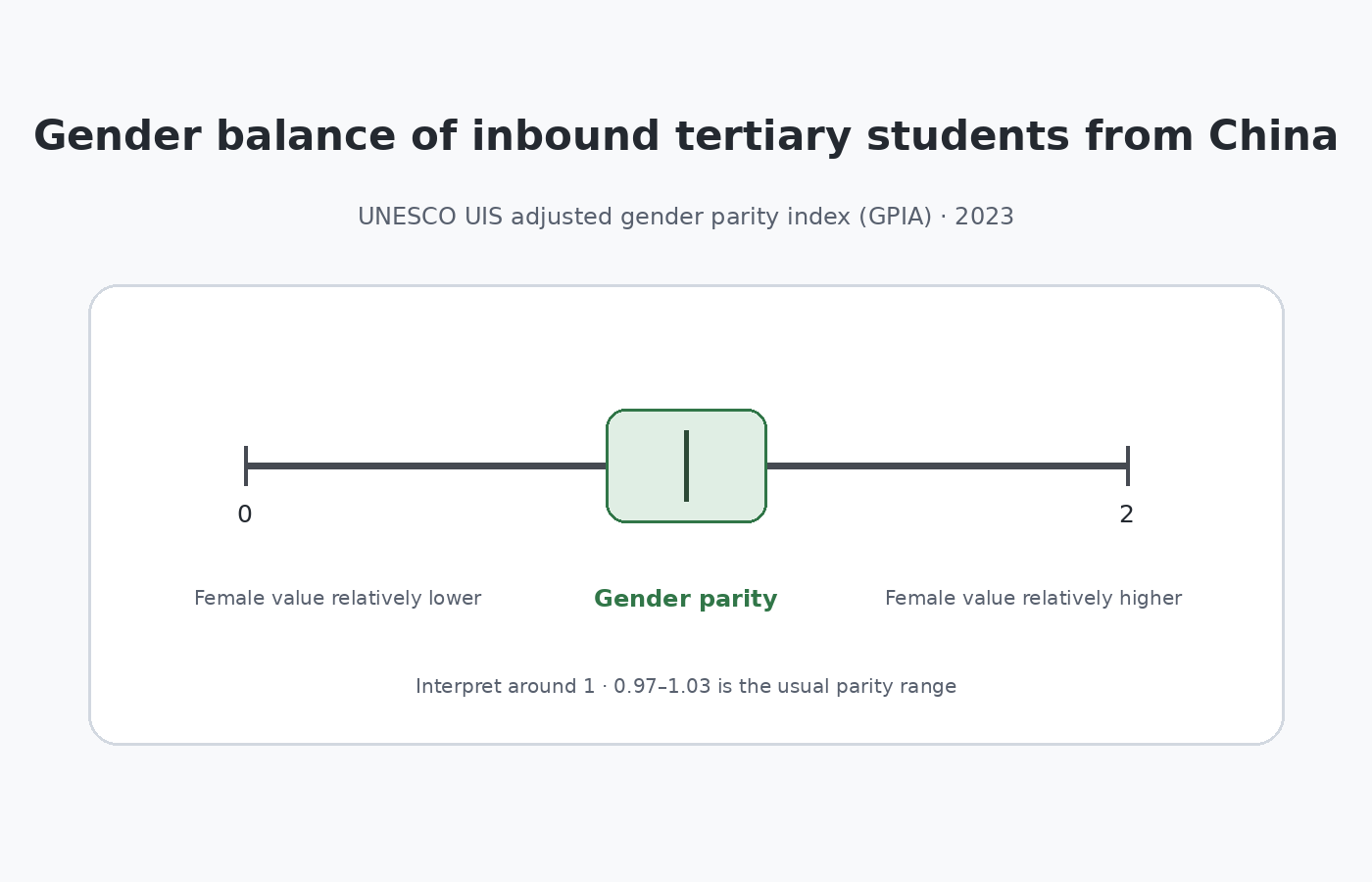
Table of Contents
China is the origin in this indicator; each reporting country is a destination
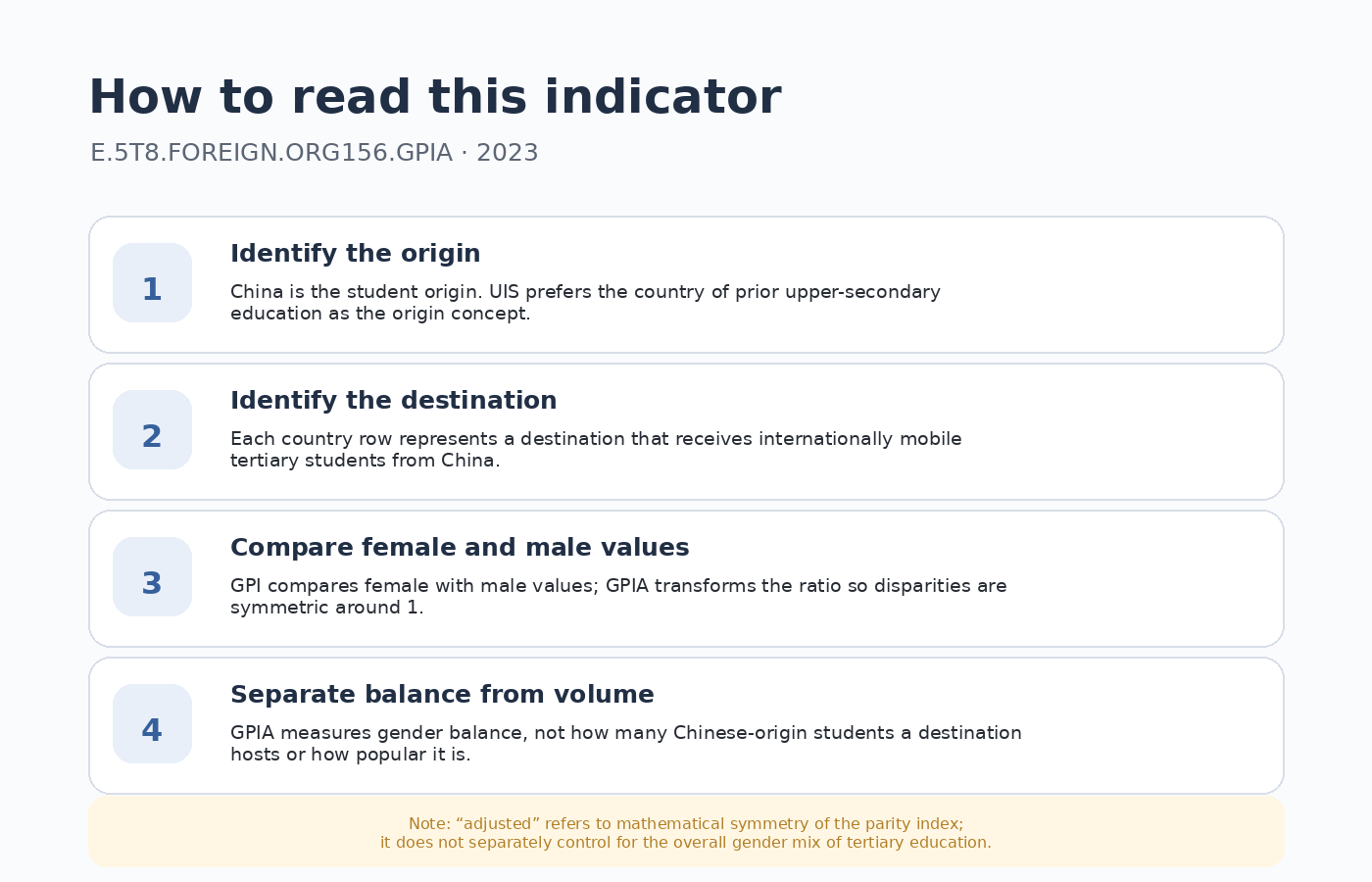
The official label begins with “Inbound internationally mobile students from Asia: Students from China.” Inbound is written from the perspective of the host or destination country. A row for a destination therefore refers to students whose origin is classified as China and who physically moved into that destination for tertiary study. It is not the gender balance of every international student in the destination, and it is not a measure of the destination’s entire tertiary student population.
This distinction prevents a common ranking mistake. A destination may host a very large number of Chinese-origin students and still have a GPIA close to 1, or it may host a small number and also have a balanced index. Another destination may have a larger gender difference despite a similar overall student volume. Student volume and gender balance therefore need separate indicators.
“Students from China” is not simply a citizenship label
UIS defines internationally mobile students as people who physically cross an international border for educational purposes and study in a country different from their country of origin. For tertiary education, the preferred origin measure is the country where the student obtained the upper-secondary qualification that gave access to tertiary study. UIS refers to this as the country of prior education.
If a reporting system cannot use prior education, UIS recommends usual or permanent residence as the next option, with citizenship as a last-resort proxy. The phrase “students from China” should therefore be understood through this origin framework. It can overlap strongly with Chinese citizenship, but the concepts are not identical by definition. That matters when comparing destinations that use different operational data sources.
International mobility requires a physical cross-border move
A foreign curriculum or foreign institution does not by itself create international student mobility. UIS excludes a student who remains in the origin country while taking distance courses offered by an institution abroad. It also excludes study at a foreign institution operating inside the origin country when the student has not physically crossed an international border for the programme.
This is why “internationally mobile student,” “foreign student,” and “student in an international programme” should not be used as interchangeable labels. The UIS concept is designed around an observable move between national education systems. Destination-country statistics based only on citizenship can therefore differ from internationally mobile student statistics based on prior education or residence.
The word “adjusted” refers to the mathematics of the parity index
A conventional gender parity index divides the female value of an indicator by the male value. If the two values are equal, the result is 1. A lower female value gives a ratio below 1, while a higher female value gives a ratio above 1. The difficulty is that the ordinary ratio is not symmetric around 1 and has no fixed upper bound.
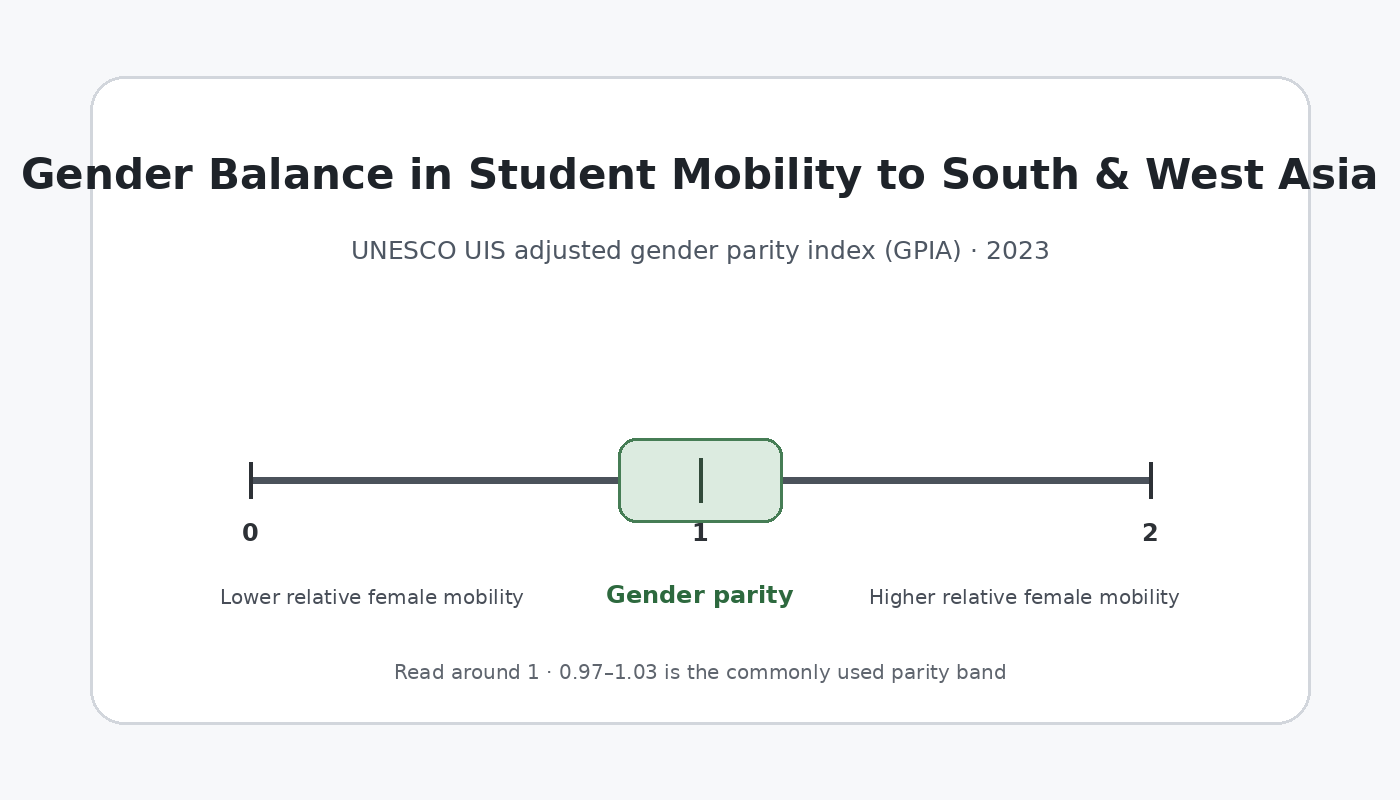
UIS solves that problem with the adjusted GPI. Let F represent the female value and M the male value. When F is less than or equal to M, GPIA is F/M. When F is greater than M, GPIA is calculated as 2−M/F. The result lies between 0 and 2 and treats equal relative disparities on opposite sides of parity as equal distances from 1. Importantly, “adjusted” does not mean that this student-mobility indicator separately controls for the overall female and male composition of tertiary education in China. It is the parity ratio itself that is mathematically adjusted.
Values from 0.97 to 1.03 are generally treated as gender parity
UIS defines exact parity at 1 and commonly uses 0.97 to 1.03 as a practical parity range so that very small differences are not overstated. For this inbound student series, a value below 1 means the female indicator value is lower than the male value; a value above 1 means the female value is higher. The farther the index lies from 1, the larger the numerical disparity between the two sex-specific values.
| GPIA range | Interpretation for Chinese-origin inbound tertiary students |
|---|---|
| Below 0.97 | Female value is relatively lower than the male value |
| 0.97–1.03 | Usual gender-parity range |
| Above 1.03 | Female value is relatively higher than the male value |
Parity should not be turned into a general quality score. A destination close to 1 is not automatically a better university system, a more welcoming immigration regime, or a more successful education market. GPIA answers a narrow descriptive question about numerical gender balance in the selected student flow.
A GPIA of 1.10 does not mean “10% more women”
Because the index is transformed above 1, its distance from 1 is not a direct percentage difference in student counts. When the female value exceeds the male value, the formula uses 2−M/F rather than simply reporting F/M. A GPIA of 1.10 therefore cannot be translated into “women are exactly 10% more numerous” without the underlying female and male values.
The benefit of the adjustment is symmetry. If one flow has the male value 1.25 times the female value and another has the female value 1.25 times the male value, the adjusted values sit the same distance from 1 on opposite sides. This makes the magnitude of disparity easier to compare, while preserving the direction of the difference.
Gender balance and destination popularity are different questions
A GPIA near 1 says nothing about how many Chinese-origin students the destination hosts. A very small group with equal female and male values can be perfectly balanced, and a very large group can also be perfectly balanced. The index does not distinguish those cases because student volume is not its purpose.
For a fuller picture of mobility, three pieces of information work better together: the female and male student counts from China, the total size of the Chinese-origin student population in the destination, and the GPIA. Additional context can include the share of all inbound mobile students that comes from China, the level of study, field of study, and time trend. Those measures answer questions that GPIA alone cannot.
The China-origin GPIA is not the same as the destination’s overall international-student GPIA
Destination countries receive students from many origins. A gender pattern among students from China can differ from the pattern among students from other places. The destination’s combined international-student population can therefore have a different gender balance from the China-origin subgroup. The subgroup indicator should not be generalized to all foreign or internationally mobile students in that country.
The reverse can also happen: the total international-student population may be close to parity while the China-origin subgroup is farther from 1. Such differences can motivate further research into degree level, subject choice, scholarship channels, language, family decisions, or labour-market expectations, but they do not identify a cause by themselves. GPIA is descriptive evidence, not a causal model.
The 75 destination observations do not represent a complete world total
The 2023 country-level series contains 75 destination observations for this indicator. That is the available comparison set for the reference year, not an automatic statement about every country in the world. A destination without a reported value may be missing because of reporting coverage, data availability, or classification issues, and should not be assigned a zero.
A simple average across 75 destination rows would also give every destination equal weight regardless of how many Chinese-origin students it hosts. Such an average is not the same as a student-weighted global gender balance. A world-level statement would need either an official aggregate or the underlying female and male counts required to construct the appropriate weighted measure.
Reporting conventions and small groups matter in cross-country comparisons
The preferred UIS origin concept is prior education, but some reporting systems must fall back to usual residence or citizenship. When metadata are available, analysts should check which operational definition was used. A difference between two destinations can reflect both real mobility patterns and differences in how origin is captured administratively.
Group size is another important limitation. If a destination hosts only a small number of Chinese-origin students, a change of a few students can move the parity index noticeably. GPIA itself does not display that denominator. Whenever possible, the index should be read with the female and male counts and with caution around fine decimal rankings among small groups.
What this indicator can and cannot tell you
The indicator is well suited to describing whether the female and male values for Chinese-origin internationally mobile tertiary students are close to parity in a destination country. Comparing the same measure across destinations can reveal where the gender composition is more balanced or more uneven. With a time series, it can also show whether a destination’s China-origin student flow has moved closer to or farther from parity.
It cannot explain why students choose a destination, whether the gender difference is caused by visa rules or scholarships, how good the universities are, whether students complete their degrees, or what happens in the labour market after graduation. Those questions require other evidence such as tuition and scholarship data, visa policy, programme level, subject of study, completion outcomes, employment data, and student surveys.
Data source and methodology
The official series belongs to UNESCO DataHub’s Other Policy Relevant Indicators (Education – OPRI) dataset, where code E.5T8.FOREIGN.ORG156.GPIA identifies the adjusted gender parity index for inbound internationally mobile tertiary students from China. UIS defines the origin and cross-border movement concepts in its internationally mobile students glossary entry.
The calculation and interpretation of adjusted parity indices are described in the UIS parity-indices methodology. The adjustment makes the index symmetric around 1 and constrains it to a 0–2 range. Country comparisons should keep the reference year, origin definition, sex-disaggregated values, group size and missing-data status visible wherever possible.
Frequently Asked Questions
Does “students from China” mean students with Chinese citizenship?
Not necessarily. UIS prefers the country of prior upper-secondary education as the origin concept, then usual or permanent residence when needed, with citizenship used only as a last-resort proxy.
Does a GPIA of 1.10 mean there are exactly 10% more women than men?
No. Values above 1 are transformed to make the index symmetric around parity, so the distance from 1 is not a direct percentage difference in counts. The underlying female and male values are needed for that comparison.
Does a GPIA near 1 mean the destination is popular with students from China?
No. GPIA measures gender balance rather than student volume. Popularity or scale requires counts of Chinese-origin students and other mobility measures.
Should a destination with no 2023 value be treated as zero?
No. Missing data and a true zero are different states. Unreported destinations should remain missing unless an official source reports a zero.
Related Articles
- Global Short-Cycle Tertiary Attainment Map | Adults 25+ by Country
- Education-Field Share Among Tertiary Graduates by Country
- Bachelor’s-or-Higher Educational Attainment by Country
Green Map creates custom-edited map images using open geographic data sources such as geoBoundaries, Natural Earth, OpenStreetMap, and government open data.
These maps are edited visual materials, not raw data files, and are provided for education, documents, presentations, and graphic reference.