How common is primary-or-higher educational attainment among adults? UNESCO Institute for Statistics indicator EA.1T8.AG25T99 measures the percentage of the population age 25 and older, both sexes, who completed primary education or any higher level.
Across the 102 country and area observations dated 2023, the unweighted median is 96.4% and the mean is 88.4%. 66 observations are at or above 90%, 56 are at or above 95%, and 36 are at or above 99%. The Republic of Korea is 97.7%, ranking 43rd among the 102 observations.
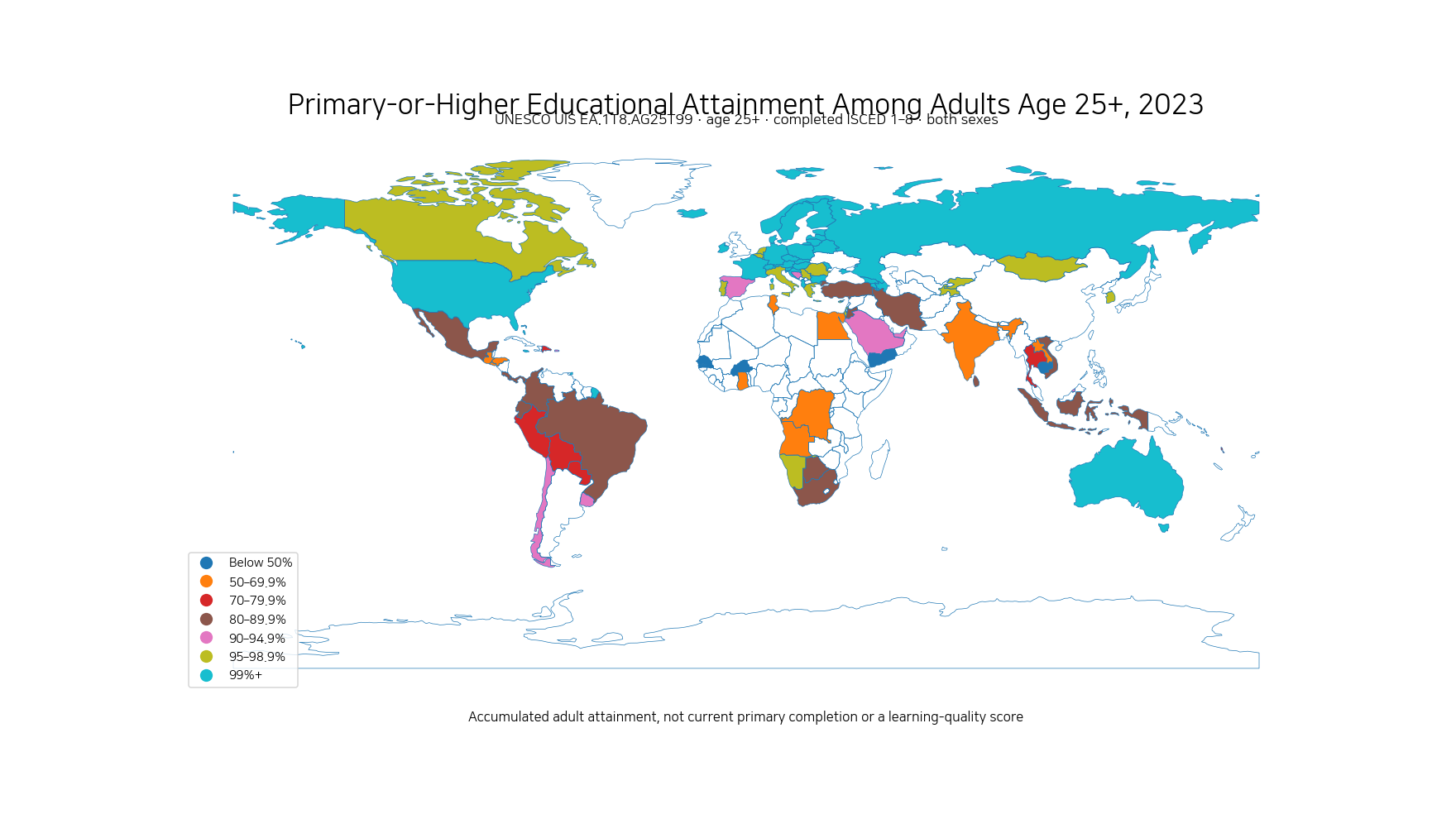
Table of Contents
This is adult educational attainment, not the current primary-school completion rate
The population in this indicator is age 25 and older. It does not track children currently completing primary school and it is not the annual graduation rate for the 2023 student cohort.
Instead, it summarizes the level of education adults accumulated over many years. For that reason, the indicator reflects historical as well as current access to schooling and changes relatively slowly when recent education policy improves.
Primary-or-higher includes every higher completed level
The code 1T8 spans ISCED levels 1 through 8. Adults who completed lower-secondary, upper-secondary, post-secondary non-tertiary, short-cycle tertiary, bachelor’s, master’s or doctoral education are all included because they completed at least primary education.
A value of 97% therefore does not mean 97% of adults stopped after primary school. It means 97% completed at least primary education, including everyone with a higher qualification.
All 102 observations use the same 2023 reference year
A useful feature of this extract is time alignment. All 102 observations are dated 2023, which avoids comparing one country’s recent adult-attainment value with another country’s older observation.
Coverage is still not universal, so the ranking should be described as the position among the 102 countries and areas with a 2023 observation rather than a complete ranking of every country in the world.
The median is 96.4%, and 66 observations are at or above 90%
The median is 96.4%, the first quartile 85.0% and the third quartile 99.4%. The relatively low threshold of primary education means that many countries report very high adult attainment.
66 observations are at least 90%, 56 are at least 95%, and 36 are at least 99%. 81 are at least 80%, while only 5 fall below 50%.
Nine observations are reported at 100%
9 observations are reported at exactly 100%: Finland, France, Germany, Denmark, Austria, Hong Kong SAR, the Russian Federation, Sweden and Iceland. Azerbaijan is 99.94%, Czechia 99.89%, Belarus 99.87% and Estonia 99.87%.
Tiny differences near 100% should not be treated as rankings of education quality. UIS notes that educational attainment records the level completed and does not necessarily reveal the quality of education. National qualification mapping to ISCED can also differ.
| Rank | Country or area | ISO3 | Primary-or-higher attainment |
|---|---|---|---|
| 1 | Finland | FIN | 100.0% |
| 2 | France | FRA | 100.0% |
| 3 | Germany | DEU | 100.0% |
| 4 | Denmark | DNK | 100.0% |
| 5 | Austria | AUT | 100.0% |
| 6 | Hong Kong SAR, China | HKG | 100.0% |
| 7 | Russian Federation | RUS | 100.0% |
| 8 | Sweden | SWE | 100.0% |
| 9 | Iceland | ISL | 100.0% |
| 10 | Azerbaijan | AZE | 99.9% |
| 11 | Czechia | CZE | 99.9% |
| 12 | Belarus | BLR | 99.9% |
| 13 | Estonia | EST | 99.9% |
| 14 | Slovakia | SVK | 99.8% |
| 15 | Slovenia | SVN | 99.8% |
| 16 | Malta | MLT | 99.8% |
| 17 | Hungary | HUN | 99.7% |
| 18 | Ireland | IRL | 99.7% |
| 19 | Norway | NOR | 99.7% |
| 20 | Poland | POL | 99.7% |
The Republic of Korea is 97.7%, above the median
The Republic of Korea records 97.7%, about 1.4 percentage points above the 96.4% median. The United States is 99.1%, Germany and France are 100%, Australia 99.5% and Canada 96.3%.
The Netherlands is 97.3%, Norway 99.7%, Spain 94.6% and Italy 98.0%. South Africa is 87.6%, Mexico 85.7%, Brazil 85.2%, Indonesia 83.8% and India 68.1%.
| Country | 2023 attainment | High-to-low rank |
|---|---|---|
| Republic of Korea | 97.7% | 43 |
| United States | 99.1% | 34 |
| Germany | 100.0% | 1 |
| France | 100.0% | 1 |
| Canada | 96.3% | 52 |
| Australia | 99.5% | 25 |
| Netherlands | 97.3% | 46 |
| Norway | 99.7% | 19 |
| Sweden | 100.0% | 1 |
| Spain | 94.6% | 57 |
| Italy | 98.0% | 42 |
| South Africa | 87.6% | 70 |
| India | 68.1% | 90 |
| Indonesia | 83.8% | 78 |
| Mexico | 85.7% | 75 |
| Brazil | 85.2% | 76 |
Burkina Faso has the lowest observation at 18.8%
Burkina Faso has the lowest 2023 observation at 18.8%. Senegal is 25.8%, Yemen 45.5%, Gambia 46.4%, Cambodia 49.0%, Angola 53.0% and Tunisia 56.6%.
These values summarize adult educational history rather than today’s primary-school access alone. Long-run school availability, conflict, household resources, gender gaps, rural-urban inequality, literacy programmes and generational differences can all contribute.
| Low-rank side | Country or area | ISO3 | Primary-or-higher attainment |
|---|---|---|---|
| 1 | Burkina Faso | BFA | 18.8% |
| 2 | Senegal | SEN | 25.8% |
| 3 | Yemen | YEM | 45.5% |
| 4 | Gambia | GMB | 46.4% |
| 5 | Cambodia | KHM | 49.0% |
| 6 | Angola | AGO | 53.0% |
| 7 | Tunisia | TUN | 56.6% |
| 8 | Honduras | HND | 62.4% |
| 9 | Guatemala | GTM | 63.1% |
| 10 | Lao People’s Democratic Republic | LAO | 63.8% |
| 11 | El Salvador | SLV | 64.5% |
| 12 | Democratic Republic of the Congo | COD | 66.1% |
| 13 | India | IND | 68.1% |
| 14 | Ghana | GHA | 68.2% |
| 15 | Egypt | EGY | 69.2% |
Why primary-or-higher attainment is high in many countries
Primary education is a relatively low threshold in the education ladder. Countries that have expanded basic schooling for several generations can approach universal primary-or-higher attainment even if upper-secondary or tertiary attainment remains much lower.
That makes this indicator useful for identifying places where basic educational completion is still not widespread among adults. In countries with low values, gaps appear before the higher stages of the education ladder are even reached.
Reading primary, lower-secondary, upper-secondary and tertiary attainment together
Primary-or-higher attainment can look nearly universal in many countries, but the distribution often changes substantially when the threshold rises to lower secondary, upper secondary or bachelor’s level.
Matched-year indicators across those thresholds can reveal where the adult education distribution narrows. But values from different years or different population definitions should not be mechanically subtracted to create a dropout or transition rate.
Attainment is not the same as literacy or learning proficiency
Completing primary education and demonstrating a specific level of reading, mathematics or problem-solving ability are different concepts. Educational attainment records formal levels completed; learning outcomes require separate assessments.
A country can therefore have near-universal primary-or-higher attainment while still facing learning gaps. Conversely, adults with limited formal schooling may have acquired skills through non-formal learning or experience.
The age-25-plus measure changes slowly
The denominator includes adults from young adulthood through older ages. Recent improvements in primary-school completion among children will affect the adult rate gradually as younger cohorts replace older cohorts.
For this reason, the indicator is best understood as accumulated educational stock rather than a one-year school-system performance measure. Time-series comparisons can show how historical expansion of basic education enters the adult population.
The map shows near-universal attainment across much of Europe, with lower values in several African and West Asian observations
Among mapped observations, the median is about 99.7% in Europe. Many European countries are in the 99% or 100% band, including Finland, France, Germany, Denmark, Austria, Sweden and Iceland.
The mapped Asian median is about 91.9% and the African median about 66.1%. The regional spread is still wide, and the same continent contains countries with very different adult-attainment histories. The map should therefore be read as a spatial distribution, not as a single regional explanation.
Blank map areas do not mean zero
The source table contains 102 country and area observations, of which 92 match separate polygons in the low-resolution world boundary layer used here. Small islands and special administrative areas can have valid statistics without a distinct visible polygon.
Countries without a 2023 value remain unclassified. Missing data are not filled with zero because that would falsely imply that no adults completed primary education.
Data source and interpretation
Country values come from the UNESCO UIS Data Browser for EA.1T8.AG25T99, using the 2023 observations. The concept follows the UIS educational-attainment definition for the population age 25 and above.
UIS defines attainment as the percentage of adults completing at least a given education level and cautions that the indicator does not necessarily reveal education quality. The source package’s internal provider tag named the World Bank, but the official indicator and dataset are UNESCO UIS, so the completed metadata corrects the provider to UNESCO UIS.
Frequently Asked Questions
Is this the 2023 primary-school graduation rate?
No. It is the cumulative share of adults age 25+ who completed primary education or a higher level at some point in the past.
Does primary-or-higher include secondary and university education?
Yes. The indicator spans ISCED levels 1 through 8, so all higher completed levels are included.
What does Korea’s 97.7% mean?
It means about 97.7% of Korea's population age 25+ in the 2023 observation had completed at least primary education.
Does a value near 100% mean education quality is highest?
No. The indicator measures the level of education completed, not learning proficiency or education quality.
Related Articles
- Global Lower-Secondary-or-Higher Attainment Map – Adults 25+ by Country
- Global Upper-Secondary-or-Higher Attainment Map – Adults 25+ by Country
- Bachelor’s-or-Higher Attainment Map – Adults 25+ by Country
Green Map creates custom-edited map images using open geographic data sources such as geoBoundaries, Natural Earth, OpenStreetMap, and government open data.
These maps are edited visual materials, not raw data files, and are provided for education, documents, presentations, and graphic reference.