Where did internationally mobile tertiary students from Ghana study in 2021? UNESCO Institute for Statistics (UIS) destination data show the largest observations in the United States at about 4,004, the United Kingdom at 2,787, and Germany at 1,656. Canada follows at 1,527 and Senegal at 1,210. The 72 reported destination observations sum to about 20,240, with the three largest destinations accounting for 41.7% of that observed sum.
The official indicator name begins with ‘Inbound internationally mobile students,’ which can be easy to misread. In this table the student origin is fixed as Ghana and each country row is a destination. The U.S. observation therefore represents Ghana-origin internationally mobile tertiary students studying in the United States; it is not the number of U.S. students going to Ghana and not the total international-student population of the United States.
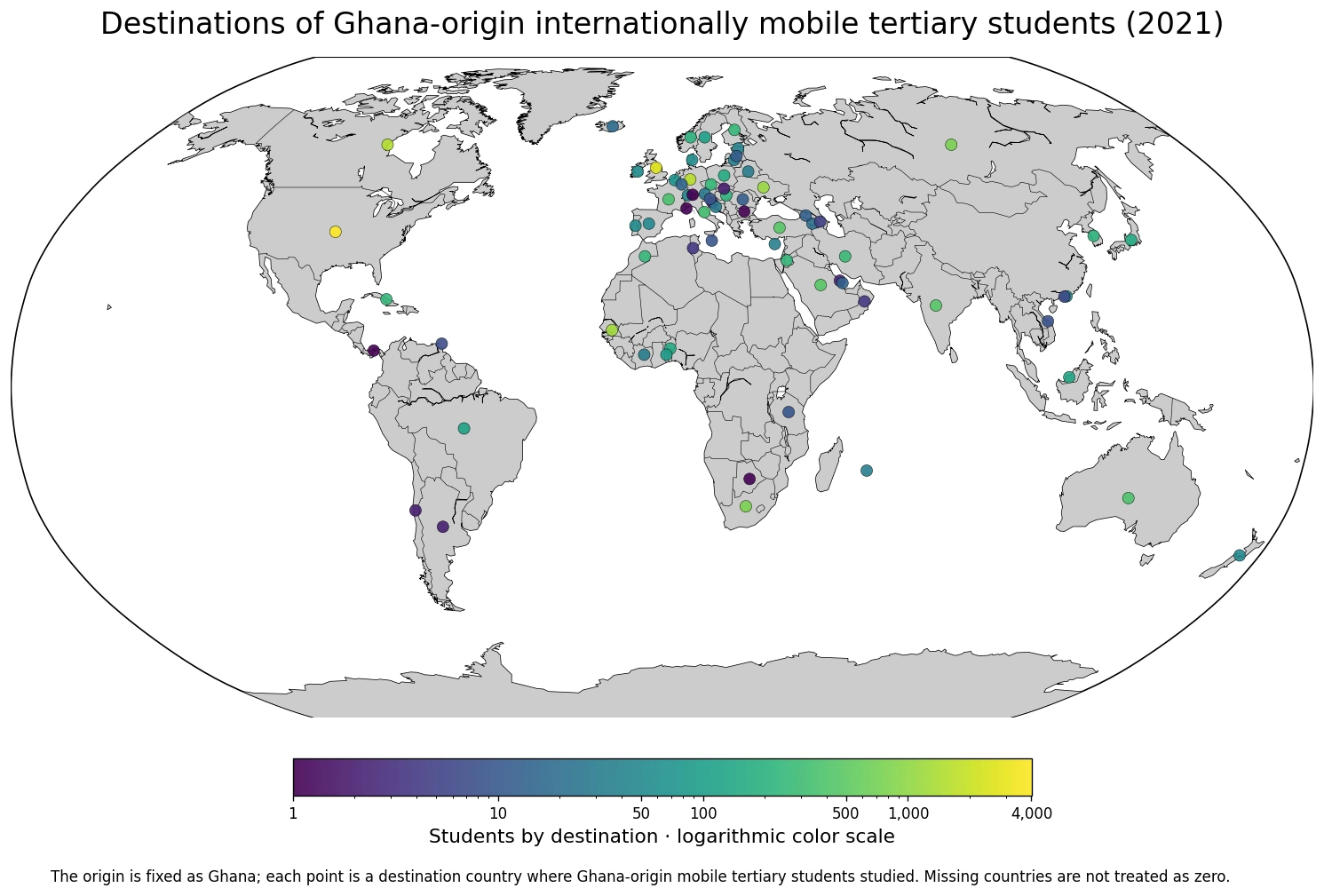
Table of Contents
The United States, United Kingdom, and Germany account for about 42% of the observed sum
The United States is the largest destination at about 4,004, followed by the United Kingdom at 2,787 and Germany at 1,656. Together they account for 41.7% of the sum across the 72 reported destinations. Adding Canada and Senegal brings the top-five share to 55.3%, while the top ten account for 72.9%.
The high end is geographically mixed. English-speaking destinations are prominent, but Ukraine, the Russian Federation, Türkiye, and Germany are also large observations. Senegal at 1,210 and South Africa at 780 show that substantial Ghana-origin tertiary mobility also occurs within Africa.
| Rank | Destination country or territory | Ghana-origin internationally mobile students |
|---|---|---|
| 1 | United States of America | about 4,004 |
| 2 | United Kingdom of Great Britain and Northern Ireland | 2,787 |
| 3 | Germany | 1,656 |
| 4 | Canada | 1,527 |
| 5 | Senegal | 1,210 |
| 6 | Ukraine | 1,130 |
| 7 | South Africa | 780 |
| 8 | Russian Federation | 755 |
| 9 | Saudi Arabia | 458 |
| 10 | India | 454 |
| 11 | Türkiye | 443 |
| 12 | Australia | 382 |
| 13 | France | 358 |
| 14 | Italy | 322 |
| 15 | Iran (Islamic Republic of) | 275 |
Six destination observations exceed 1,000 students
6 of the 72 destinations have at least 1,000 students, while 2 are between 500 and 999 and 21 between 100 and 499. At the other end, 19 destinations are below 10 and another 17 are between 10 and 49.
| Destination-count band | Countries or territories | Share of observations |
|---|---|---|
| Below 10 | 19 | 26.4% |
| 10–49 | 17 | 23.6% |
| 50–99 | 7 | 9.7% |
| 100–499 | 21 | 29.2% |
| 500–999 | 2 | 2.8% |
| 1,000 or more | 6 | 8.3% |
The median is 50 students and the mean is 281.1. The middle half of the observations runs from 9 to 247. The mean is much higher than the median because a small number of major destinations contribute thousands of students each. For this long-tailed distribution, concentration shares and the median describe the pattern better than the mean alone.
Ghana-origin does not simply mean Ghanaian citizenship
The UIS glossary defines internationally mobile students as people who physically cross an international border for education and study in a destination country different from their country of origin. For tertiary students, the preferred origin definition is the country where the student obtained the upper-secondary qualification—the country of prior education.
If prior-education information is unavailable, countries are advised to use usual or permanent residence, and citizenship only as a last resort. For that reason, ‘students from Ghana’ should not automatically be rewritten as a pure citizenship count. The concept is designed to identify educational mobility, not simply foreign nationality.
Distance learning and short-term exchange are not the same thing as UIS international mobility
Physical cross-border movement is central to the UIS definition. A student remaining in Ghana while taking a distance-learning programme from a foreign institution is not internationally mobile under this concept. A foreign institution operating a programme inside Ghana also does not create international mobility if the student does not cross a border.
Short exchange arrangements can also be treated differently from degree or diploma mobility, particularly when credits remain attached to the home institution. The 26442 series is therefore a standardized tertiary-mobility measure rather than a count of every possible overseas educational experience.
Senegal and South Africa show that intra-African mobility is substantial
Senegal is the fifth-largest destination at 1,210 students and South Africa is seventh at 780. Morocco records 246, Benin 152, and Togo 92. These observations make clear that Ghana-origin tertiary mobility is not limited to Europe and North America.
The dataset does not explain why particular destinations are chosen. Language, tuition, scholarships, programme availability, institutional partnerships, family networks, visa pathways, and historical ties could matter, but indicator 26442 contains no variables that isolate those causes. The map supports statements about destination size, not causal explanations.
Ukraine and the Russian Federation make the 2021 reference year especially important
Ukraine records 1,130 students and the Russian Federation 755, placing both among the largest destinations in the 2021 data. These values describe the international-student geography of that year. They should not be assumed to represent today’s destination pattern or to include the effects of later political and security developments.
Student mobility can shift rapidly as visa rules, travel conditions, university operations, safety, currency values, and costs change. This article therefore treats the dataset as a 2021 snapshot. A trend claim would require the same Ghana-origin destination series across multiple years.
The observed sum of about 20,240 should not automatically be called Ghana’s complete outbound total
Adding the 72 destination observations gives about 20,240. Destination-country reporting coverage and data availability can vary, so this observed sum should not automatically be presented as an exhaustive official count of every Ghana-origin tertiary student abroad in 2021.
The sum is useful as a consistent denominator for describing concentration within the supplied dataset. For example, it supports the top-three, top-five, and top-ten destination shares calculated here. Countries without an observation are not assigned zero, because missing data and a confirmed zero are different statistical statements.
Decimal observations are official statistical values, not fractional people
Most destination values are integers, but a few—including the United States and Sweden—contain decimals in the UIS extract. These should not be read literally as fractions of a student. They can reflect estimation or statistical adjustment within an internationally comparable series.
The calculations in this article retain the original decimal values. Reader-facing count tables round those observations to the nearest student and mark them as approximate where needed. Small differences among low-volume destinations should therefore not be treated as exact person-by-person rankings.
Blank areas on the map are not zero-student destinations
The map uses representative locations for the 72 destination observations. Countries with no supplied 2021 value are left unplotted rather than assigned zero. That distinction is important because ‘no observation’ does not mean that no Ghana-origin student studied there.
A logarithmic color scale is used because the observed range stretches from 1 to about 4,004 students. Point size does not encode the count; color does. The scale makes small destinations visible without losing the contrast created by the major destinations.
Data scope and source
The analysis uses 72 destination-country observations for 2021 from the UNESCO Institute for Statistics official API indicator 26442. The topic is ‘Inbound internationally mobile students from Africa: Students from Ghana, both sexes (number)’. Ghana is fixed as the student origin, while each row is a destination country.
The observed sum of about 20,240, median of 50, top-three share of 41.7%, and destination-count bands are calculated directly from the supplied data. The UIS internationally mobile student definition is used for interpretation. Missing destinations are not converted to zero, and all public comparisons remain tied to the 2021 reference year.
The main takeaway
The largest reported 2021 destinations for Ghana-origin internationally mobile tertiary students are the United States at about 4,004, the United Kingdom at 2,787, and Germany at 1,656. Those three destinations account for 41.7% of the observed sum, and the top five account for 55.3%. At the same time, Senegal and South Africa show that intra-African mobility is an important part of the distribution. The indicator describes destination patterns for Ghana-origin tertiary students in 2021; it does not by itself measure current preferences, explain why students chose those destinations, or provide a complete global total.
Frequently Asked Questions
Are the countries in this dataset student origins or destinations?
They are destinations. Ghana is fixed as the origin, and each value shows Ghana-origin internationally mobile tertiary students studying in that destination country.
Does Ghana-origin mean the same thing as Ghanaian citizenship?
Not necessarily. UIS prefers the country of prior upper-secondary education, then usual residence, and uses citizenship only as a last-resort proxy.
Which destinations are largest in the 2021 data?
The United States is highest at about 4,004, followed by the United Kingdom at 2,787 and Germany at 1,656.
Related Articles
Green Map creates custom-edited map images using open geographic data sources such as geoBoundaries, Natural Earth, OpenStreetMap, and government open data.
These maps are edited visual materials, not raw data files, and are provided for education, documents, presentations, and graphic reference.