The official age at which children enter pre-primary education is surprisingly concentrated across education systems. In the UNESCO Institute for Statistics (UIS) 2025 dataset, 223 countries and separately reported areas have values from age 2 to age 6. Age 3 is by far the dominant setting: 159 observations, or 71.3% of the total. Another 44 are set at age 4. Together, ages 3 and 4 account for 203 of the 223 observations, or 91.0%. The central story is therefore not a broad spread across childhood but a strong clustering around the ages immediately before primary school.
This indicator should not be read as the average age at which children actually begin kindergarten, preschool, childcare, or any early-childhood service. UIS defines an official entrance age as the age at which students would enter a specified programme or level under the formal structure of the education system. Indicator 299902 refers specifically to the official entrance age for pre-primary education, corresponding to ISCED 02. Actual participation, the age at which families first use childcare, the compulsory-school starting age, the duration of pre-primary education, and the number of free years are separate questions.
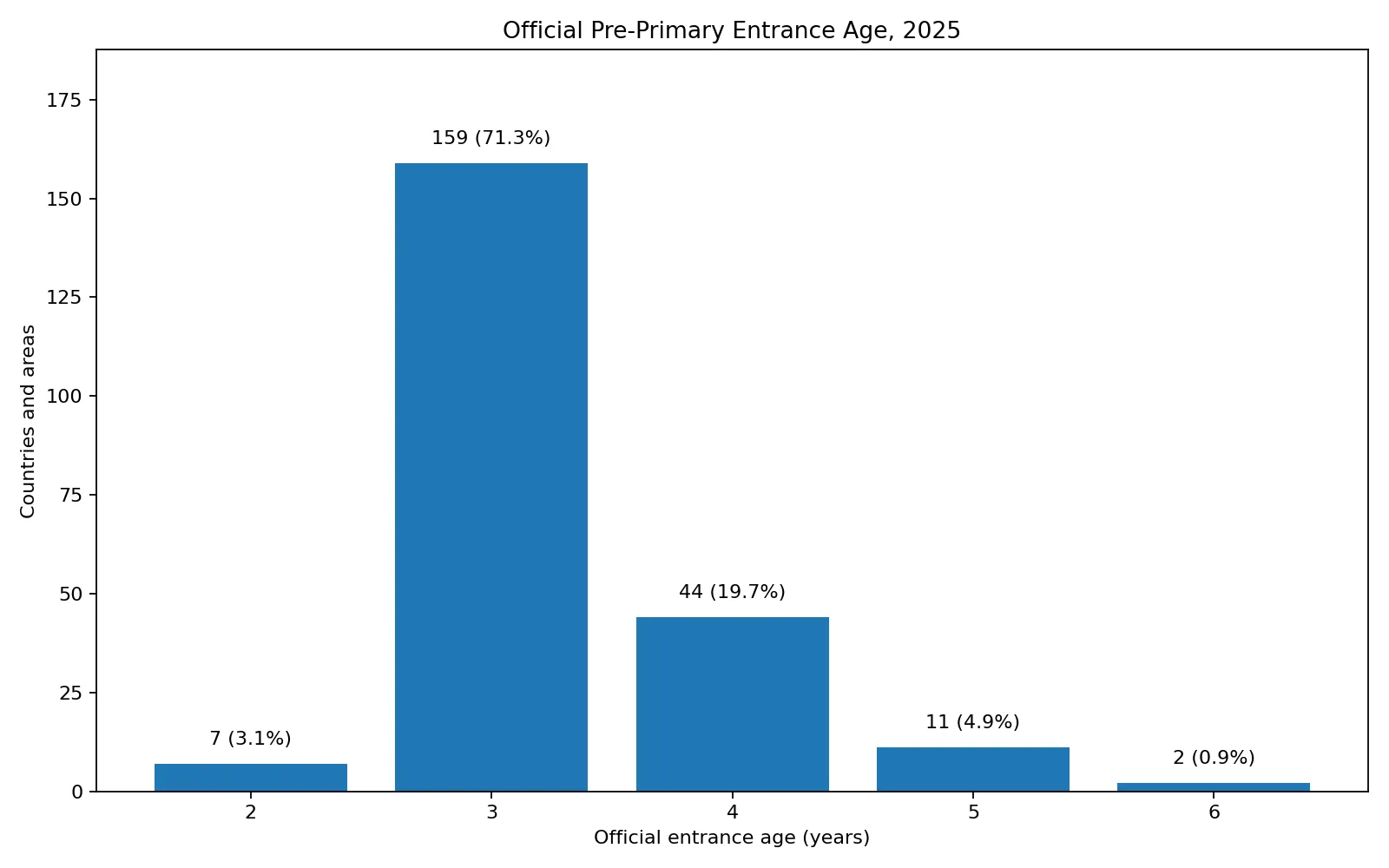
Table of Contents
What the official entrance age actually measures
The UIS glossary describes official entrance age as the age at which students would enter a programme or education level if they entered the lowest level at its official age, studied full-time, and progressed through the system without repeating or skipping grades. The official age is typically, though not always, the most common entrance age in practice. That distinction matters. A value of 3 does not mean every child enters on the third birthday, nor does it imply that all children in the country are enrolled. School-year cut-off dates, birth-month rules, early-entry provisions, delayed entry, and local exceptions can produce a wider distribution of actual student ages.
Pre-primary education is also narrower than the full universe of early-childhood care and education. ISCED level 0 includes both early childhood educational development, generally targeted at younger children, and pre-primary education, which is oriented toward children approaching the start of primary schooling. Indicator 299902 concerns the formal entrance point to the pre-primary stage. A country can therefore have extensive services for children younger than the reported age while still recording an official pre-primary entrance age of 3 or 4. Conversely, an early official starting age does not prove that participation is universal.
For cross-country comparison, this makes the indicator a structural measure rather than an outcome score. It answers “At what age does the formal pre-primary stage begin?” It does not answer “How good is the system?”, “How many children attend?”, or “How much does government spend?” An earlier starting age should not automatically be ranked as better, and a later starting age should not automatically be treated as evidence of weak commitment to early childhood. Countries organize the boundary between childcare, early-childhood development, pre-primary education, and primary school in different ways.
Age 3 dominates, and ages 3–4 cover 91% of observations
All 223 observations are reported for 2025 and use whole-year values. Seven countries or areas are at age 2, 159 at age 3, 44 at age 4, 11 at age 5, and two at age 6. The median is 3 years, the first quartile is 3, and the third quartile is 4. The simple unweighted mean is about 3.29 years. Because the higher-age groups contain more observations than the age-2 group, the mean sits a little above the median. For describing the most typical system, however, the median and mode of 3 years are more direct than the decimal mean.
| Official entrance age | Countries/areas | Share of 223 |
|---|---|---|
| 2 years | 7 | 3.1% |
| 3 years | 159 | 71.3% |
| 4 years | 44 | 19.7% |
| 5 years | 11 | 4.9% |
| 6 years | 2 | 0.9% |
The 203 observations at ages 3 or 4 represent 91.0% of the dataset. A one-year difference may look small on a chart, but it can be meaningful in system design. Starting pre-primary education at 3 rather than 4 can change the number of years that potentially fit before primary entry, the age bands covered by the curriculum, staffing arrangements, and the administrative boundary between childcare and education. Yet the entrance-age indicator alone does not reveal the official duration. To determine how many years a child is expected to spend in pre-primary education, the entrance age must be read alongside the official primary entrance age or a duration measure.
Age 2 and age 6 are rare ends of the 2025 distribution
The age-2 group contains Georgia, Guadeloupe, French Guiana, Mongolia, Martinique, Réunion, and Saint Pierre and Miquelon. That is only seven observations, or 3.1% of the total. Several are separately reported territories rather than sovereign states, which is why “countries and areas” is the more accurate description of the dataset. Their value indicates that the formal pre-primary stage begins at age 2 under the reported education structure. It does not imply that every two-year-old is enrolled or that the programme is compulsory.
At the other end, only Afghanistan and the United Republic of Tanzania are reported at age 6. The age-5 group includes Algeria, Indonesia, Iran, Liechtenstein, Namibia, Nigeria, the Philippines, and several separately reported areas. These are later formal entrance points relative to the global concentration at age 3, but they are not a ranking of education access or quality. A later pre-primary entrance age may coexist with other early-childhood programmes for younger children, a later primary-school entrance age, or a different administrative separation between care and education. Explaining the reason for any individual country requires its national education structure and legal framework.
The same age does not mean the same education system
The fact that 159 observations share an official age of 3 does not make those systems equivalent. One country may provide several years of formal pre-primary education before primary school while another has a different primary entrance age and therefore a different official duration. The balance between public and private provision can also vary dramatically. Some systems make pre-primary education free or compulsory for certain ages, while others do not. Teacher qualifications, curriculum, class size, funding, and local availability can differ even when the official entrance age is identical.
The indicator becomes more informative when paired with participation measures. A system can define age 3 as the formal start while enrolling only part of the eligible population. Another can start formally at age 4 but achieve very high participation at that age. Similarly, a country with a high private share of pre-primary enrolment can have the same official entrance age as a predominantly public system. The entrance-age statistic is therefore best used as a reference point for interpreting other education indicators rather than as a substitute for enrolment, access, financing, or learning measures.
Selected countries can be compared on a clean 2025 basis
A useful feature of this dataset is that every retained row is dated 2025. Many education datasets combine the latest available value from different years, which can make a ranking partly a comparison of time periods. That problem is absent here. The United States, Canada, Japan, China, India, Germany, France, the United Kingdom, and Australia are all reported at age 3. The Republic of Korea is also at age 3. Brazil is at age 4, while Indonesia and Nigeria are at age 5. These values describe formal system entry points in the same reference year, not a hierarchy of education performance.
| Country | Official entrance age in 2025 |
|---|---|
| Republic of Korea | 3 years |
| United States | 3 years |
| Canada | 3 years |
| Japan | 3 years |
| China | 3 years |
| India | 3 years |
| Germany | 3 years |
| France | 3 years |
| United Kingdom | 3 years |
| Australia | 3 years |
| Brazil | 4 years |
| Mexico | 3 years |
| Indonesia | 5 years |
| South Africa | 3 years |
| Nigeria | 5 years |
For example, comparing Brazil at 4 with Indonesia at 5 and a large set of age-3 countries supports one direct statement: the formal pre-primary stage begins later under the reported structure. It does not support the claim that children receive no education or care before that age. In the same way, an age-3 value for the United States or Japan does not mean every child attends a uniform publicly provided school beginning at exactly age 3. International classifications create a common statistical frame, but national and subnational arrangements remain diverse.
What this indicator cannot tell you
Official entrance age is precise but narrow. First, it does not measure the enrolment rate. A country can have an official starting age of 3 and still have low participation among three-year-olds. Second, it does not state whether pre-primary education is free or compulsory. Those legal entitlements require separate indicators. Third, it says nothing directly about programme quality, staffing, teacher training, class size, learning outcomes, household cost, or geographic availability. Using this one number as a comprehensive early-childhood score would therefore overstate what the source measures.
There is also no evidence in the indicator itself that an earlier age is universally preferable. Earlier formal entry may create the possibility of a longer pre-primary pathway, but outcomes depend on programme quality, accessibility, financing, family choice, teacher capacity, and the relationship between care and education. A system with a later pre-primary entry age may still offer extensive services to younger children under a different programme classification. The appropriate use of this dataset is descriptive: it shows where the formal ISCED 02 stage begins.
Actual student age distributions can differ from the official age as well. School-year cut-off dates can place children with different birthdays in the same cohort, and some systems allow early or delayed entry. UIS itself notes that the official entrance age is typically but not necessarily the most common observed entrance age. Researchers interested in actual behaviour would need administrative enrolment records or household survey data rather than a structural indicator alone.
The 3.29-year mean is not the average start age of the world’s children
A simple average of the 223 official values is about 3.29 years, but that figure should never be rewritten as “children worldwide start pre-primary education at age 3.29 on average.” Every country or separately reported area contributes one row regardless of population. A very large country and a small island therefore have equal weight in the calculation. The values are also official system ages, not individual children’s observed starting ages. The mean is useful only as a summary of how the institutional settings are distributed across reporting units.
The median of 3, the mode of 3, and the 91.0% concentration at ages 3–4 communicate the distribution more clearly. Only two observations are at age 6 and seven are at age 2. The dataset is therefore characterized by a strong central norm with a small set of earlier and later institutional designs. That pattern is more informative than a league table because the statistic is not intended to measure success.
Source and calculation method
The underlying source is UNESCO Institute for Statistics indicator 299902, Official entrance age to pre-primary education (years). The analysis uses all 223 verified country and area rows dated 2025. The source values are used directly without transformation. Counts, shares, quartiles, the median, and the simple mean are calculated from those rows, with each reporting unit receiving equal weight. The conceptual definition follows the UNESCO UIS glossary.
The official country-level observations can be checked through the UIS API for indicator 299902. The visual in this article uses a distribution chart rather than forcing the data into a geographic boundary map. That choice preserves all 223 observations, including small islands and separately reported territories that may not have a visible polygon in a simplified world map. Missing values are not converted to zero; in this 2025 dataset, all 223 retained rows have a reported value.
Frequently Asked Questions
What does an official pre-primary entrance age of 3 mean?
It means the formal education structure sets age 3 as the entrance age for pre-primary education, or ISCED 02. It does not mean every child actually enrolls at exactly age 3.
Does an earlier official entrance age mean a better pre-primary system?
No. This indicator measures only the formal starting age. It does not measure enrolment, quality, whether education is free or compulsory, teacher conditions, or learning outcomes.
Are all 223 observations from the same year?
Yes. All 223 country and area observations used in this comparison are dated 2025, so the distribution does not mix different reference years.
What is the most common official pre-primary entrance age?
Age 3. It appears in 159 of 223 observations, or 71.3%. Ages 3 and 4 together account for 91.0% of the dataset.
Related Articles
- Compulsory education duration by country in 2025
- Private share of pre-primary enrolment across countries
- Primary education attainment among adults age 25+ by country
Green Map creates custom-edited map images using open geographic data sources such as geoBoundaries, Natural Earth, OpenStreetMap, and government open data.
These maps are edited visual materials, not raw data files, and are provided for education, documents, presentations, and graphic reference.