Completing primary education or a higher level is one measure of accumulated schooling among adults. A different question is whether women and men reach that threshold at similar rates. UNESCO Institute for Statistics (UIS) reports an adjusted gender parity index, or GPIA, that makes that comparison directly. In the 2023 observations used here, 96 countries and separately reported areas have values for adults age 25 and older.
The key point is that GPIA is not an attainment percentage. It does not tell us what share of adults completed primary education or higher. Instead, it compares the female attainment rate with the male attainment rate. A country can therefore be close to gender parity even when its overall attainment level is low, and a country with high overall attainment can still show a gender gap.
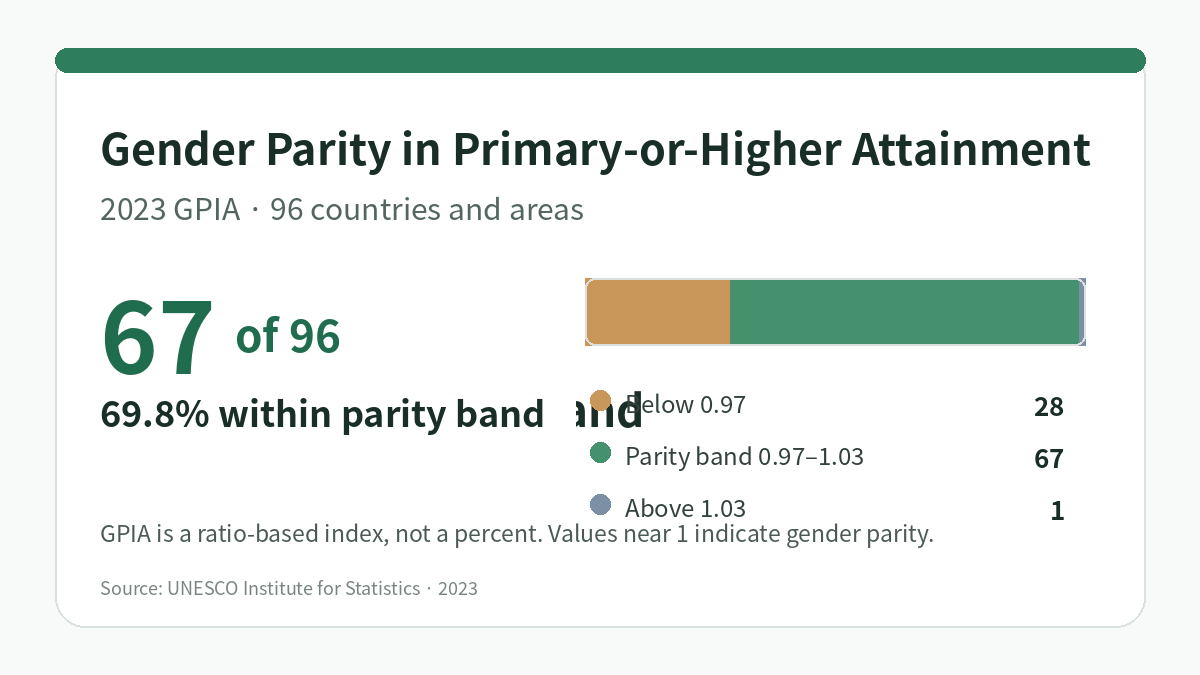
Table of Contents
What a GPIA value of 1 means
UIS starts from the female-to-male ratio for an indicator and adjusts the ratio when the female value is higher so that the resulting index is symmetrical around 1. The adjusted index ranges from 0 to 2. A value of 1 means parity between women and men for the underlying indicator.
For this topic, the underlying indicator is educational attainment at primary level or higher among people age 25 and older. Because a higher attainment rate is a favorable outcome, a GPIA below 1 points to a lower female attainment rate relative to the male rate, while a value above 1 points in the opposite direction. UIS commonly treats values from 0.97 to 1.03 as a practical parity band.
Values above 1 should not be read as simple percentages. When the female value exceeds the male value, UIS applies an adjustment rather than leaving the raw female-to-male ratio unchanged. The safest interpretation is therefore to look at the direction of the gap and the distance from 1.
67 of 96 observations fall inside the parity band
Among the 96 observations for 2023, 67 countries and areas, or 69.8%, fall between 0.97 and 1.03. Another 28 observations, or 29.2%, are below 0.97. Only one observation, Bahrain, is above 1.03. The median value is about 0.997, very close to parity, while the mean is lower at about 0.950 because a relatively small group of low-end observations pulls the average down.
| GPIA range | Interpretation for this attainment indicator | Rows | Share |
|---|---|---|---|
| Below 0.97 | Female attainment is lower than male attainment beyond the usual parity band | 28 | 29.2% |
| 0.97 to 1.03 | Commonly used parity band | 67 | 69.8% |
| Above 1.03 | Female attainment is higher than male attainment beyond the usual parity band | 1 | 1.0% |
These percentages describe only the 96 countries and separately reported areas with a 2023 value in this series. They should not be generalized into a precise share of all countries worldwide because many countries do not appear in the 2023 set.
The largest gaps are on the below-1 side
The observations farthest below parity are concentrated in a smaller group. Yemen has the lowest value at 0.474, followed by Burkina Faso at 0.617, Angola at 0.641, Senegal at 0.655, and the Democratic Republic of the Congo at 0.666. Cambodia, the Gambia, India, Lao PDR and Tunisia also sit well below the 0.97 lower bound.
| Country or area | 2023 GPIA | Distance from 1 |
|---|---|---|
| Yemen | 0.474 | 0.526 |
| Burkina Faso | 0.617 | 0.383 |
| Angola | 0.641 | 0.359 |
| Senegal | 0.655 | 0.345 |
| Democratic Republic of the Congo | 0.666 | 0.334 |
| Cambodia | 0.734 | 0.266 |
| The Gambia | 0.745 | 0.255 |
| India | 0.766 | 0.234 |
| Lao PDR | 0.775 | 0.225 |
| Tunisia | 0.803 | 0.197 |
When GPIA is at or below 1, the adjusted index is the female indicator value divided by the male value. Yemen’s 0.474 therefore indicates that the female attainment rate underlying this index is roughly 47% of the male rate. That describes the size and direction of the disparity, but it does not explain its causes. Explaining a gap would require additional evidence on schooling access, age cohorts, household resources, conflict exposure, geography, institutions and other factors.
Most observations above 1 still remain within the parity band
Bahrain is the only 2023 observation above 1.03, at 1.035. Honduras is 1.029, Nauru 1.024, the Dominican Republic 1.021, Colombia 1.016 and Brazil 1.015. Those values are above 1, meaning the female attainment measure is higher than the male measure in direction, but all except Bahrain remain within the usual 0.97–1.03 parity interval.
This distinction matters. “Female value higher than male value” and “outside the parity band” are not the same statement. Small differences around 1 are normally treated as parity, and the adjusted formula for values above 1 means that a number such as 1.035 should not be translated into a literal claim that female attainment is 3.5% higher.
Korea is just below the usual lower bound
The Republic of Korea has a 2023 GPIA of 0.969, only about 0.001 below the commonly used 0.97 lower bound. The United States is 0.999, Germany 1.000, Brazil 1.015 and the United Arab Emirates 0.970. Korea is therefore better described as very close to the parity threshold than as one of the large-gap observations.
| Country | 2023 GPIA | Parity-band reading |
|---|---|---|
| Republic of Korea | 0.969 | Just below the lower bound |
| United States | 0.999 | Within parity band |
| Germany | 1.000 | Within parity band |
| Brazil | 1.015 | Within parity band |
| United Arab Emirates | 0.970 | Within parity band |
| India | 0.766 | Below 0.97 |
This comparison still says nothing about the absolute level of attainment. Two countries can both have a GPIA of 1.000 even if one has very high primary-or-higher attainment for both sexes and the other has much lower attainment for both sexes. The index answers a parity question, not a level question.
Parity and attainment level should be read together
GPIA is useful because it isolates a relative gender difference that can be hidden when looking only at total population averages. But it should be paired with the actual attainment rates. If a country has a low GPIA, the next step is to inspect female and male attainment separately and then compare the overall percentage of adults who completed primary education or higher.
The reverse is equally important. A GPIA near 1 can coexist with weak overall attainment. In that case, the country may have little gender disparity at this threshold but still face a broad challenge in raising educational attainment for both women and men. This is why a parity index should not be used as a substitute for the underlying education level.
What this dataset cannot tell us
- GPIA does not measure learning quality, literacy skills, test performance or labor-market outcomes.
- The 2023 set contains 96 reporting countries and areas, not every country in the world.
- The index cannot identify the causes of a gender gap by itself.
- Because the population is age 25 and older, the measure combines older and younger adult cohorts and may respond slowly to recent reforms.
- A value near 1 means gender parity for the indicator, not necessarily high attainment for both sexes.
Data source and calculation
The analysis uses 2023 national-level observations for UNESCO Institute for Statistics indicator EA.1T8.AG25T99.GPIA. There are 96 non-missing country or area rows in the comparison. The counts, shares, mean, median and ranking tables above were calculated directly from those observations.
UIS defines the adjusted gender parity index as a ratio-based index centered on 1 and adjusted when the female indicator value exceeds the male value. The practical parity band of 0.97 to 1.03 is widely used in UIS reporting. For that reason, the measurement should be described as an index or ratio, not as a percentage.
Frequently Asked Questions
What does a GPIA of 1 mean?
It means the female and male values of the underlying attainment indicator are equal. UIS commonly treats 0.97 to 1.03 as a practical gender-parity band.
Does a GPIA below 1 mean women have lower attainment?
For this positive educational-attainment indicator, yes. A value below 1 points to a lower female attainment rate relative to the male rate.
Does a GPIA near 1 mean educational attainment is high?
No. GPIA measures gender parity, not the overall attainment level. Both female and male attainment can be low while the index remains close to 1.
What is Korea’s 2023 GPIA in this dataset?
The Republic of Korea is 0.969, just below the commonly used 0.97 lower bound of the parity band.
Related Articles
- Primary-or-higher educational attainment for adults 25+ by country
- Lower-secondary-or-higher attainment for adults 25+ by country
- Bachelor’s-or-higher educational attainment by country
Green Map creates custom-edited map images using open geographic data sources such as geoBoundaries, Natural Earth, OpenStreetMap, and government open data.
These maps are edited visual materials, not raw data files, and are provided for education, documents, presentations, and graphic reference.