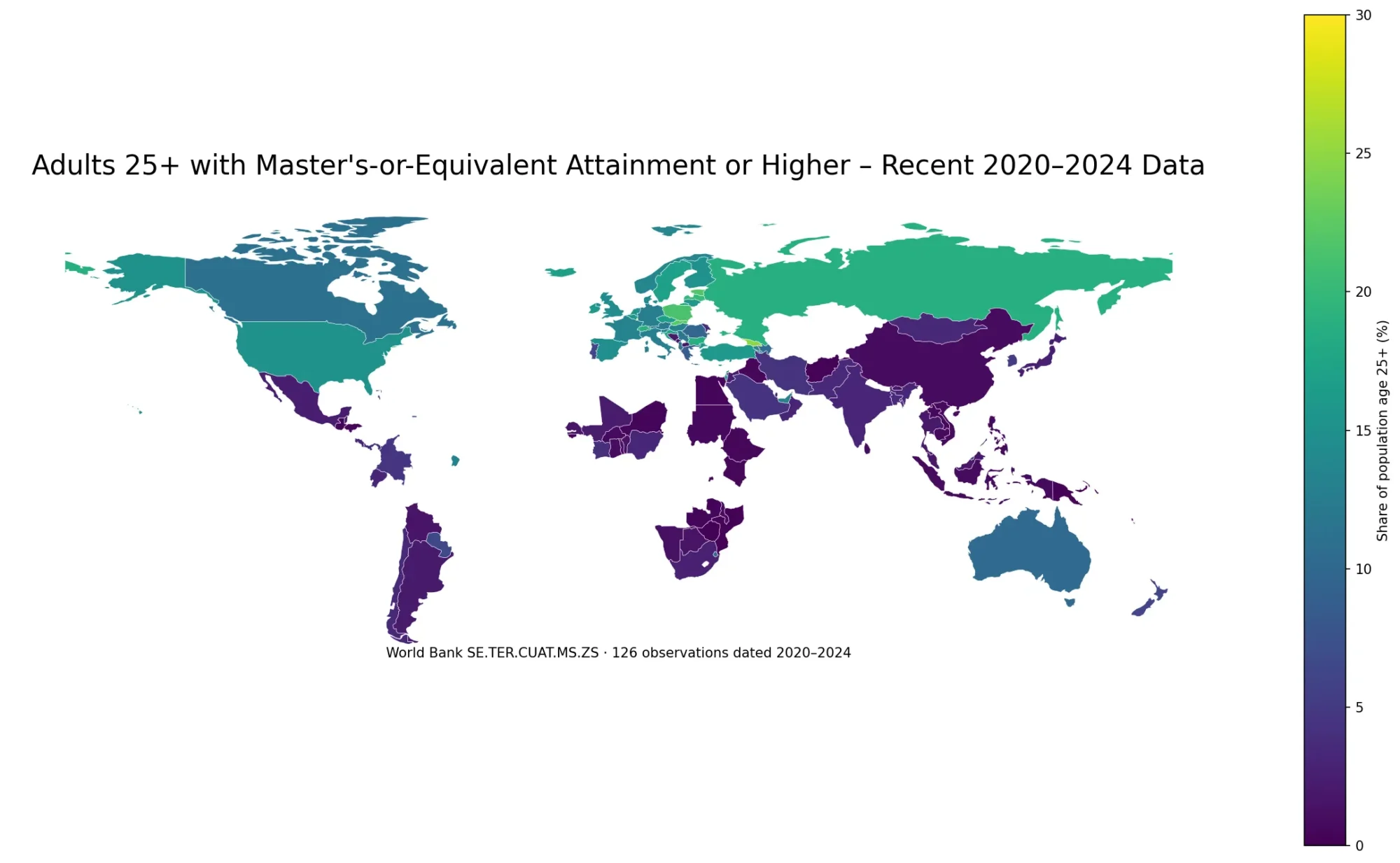
UNESCO UIS data for 2024 show that the female share of enrolment in public early childhood educational development programmes is close to 50% in most of the 39 reporting economies. The median is 48.5%, the mean is 48.2%, and the middle half of observations runs from 48.2% to 48.9%. Jamaica has the highest reported share at 55.0%, while Qatar has the lowest at 34.3%.
The indicator is easy to misread. It is not the percentage of girls who attend public institutions. It is the female share of all enrolment in public early childhood educational development programmes. A value near 50% therefore indicates a roughly even female/male composition among enrolled children in those public programmes. In this dataset, 28 of 39 observations fall between 48% and 52%, and 33 fall between 47% and 53%.

Table of Contents
How to read the indicator correctly
UNESCO UIS indicator ETOIP.01.PU.F reports the percentage of enrolment in public early childhood educational development programmes that is female. Values above 50% mean girls were the larger group among reported enrolments; values below 50% mean boys were the larger group. The measure describes composition within public programmes. It does not directly measure the proportion of the child population enrolled, the availability of public places, or the overall participation rate in early childhood education.
Coverage is another important limit. The verified 2024 file contains 39 reporting countries and economies. Economies not listed in the file are missing observations for this comparison and must not be treated as zero. The results therefore describe the reporting set rather than a complete world average. That distinction matters when the values are mapped or summarized.
Most reported economies cluster near an even split

The distribution is unusually concentrated around the midpoint. The standard deviation is about 3.3 percentage points. 6 economies are above 50%, and only 2 are below 45%. This is a very different pattern from indicators in which countries span almost the full 0–100% range. Here, most variation is a few percentage points around an approximately balanced female/male composition.
There is no single regional pattern that explains all of the variation. Several European economies sit between 48% and 49%, while Cyprus is above 52%. In Latin America, Chile, Brazil, Mexico, and Peru are close to 48%, but Costa Rica is much lower at 37.4% and Jamaica is much higher at 55.0%. Ghana is near 49% while Senegal is above 52%. Differences within regions are large enough that broad regional labels would hide important exceptions.
Reporting economies with the highest female shares
| Economy | Female share |
|---|---|
| Jamaica | 55.0% |
| Cyprus | 52.5% |
| Senegal | 52.3% |
| San Marino | 51.7% |
| El Salvador | 50.3% |
| Morocco | 50.1% |
| Cuba | 49.6% |
| Ghana | 49.3% |
| Niue | 49.0% |
| New Zealand | 48.9% |
Jamaica is the highest observation at 55.0%, followed by Cyprus at 52.5% and Senegal at 52.3%. San Marino is also above 51%, while El Salvador and Morocco are just over 50%. Even the maximum is only about five percentage points above an even split. The upper end is therefore better described as a modest female majority rather than an overwhelmingly female enrolment structure.
A high female share should not be turned into a general score for gender equality or early-childhood access. It says nothing by itself about how many girls of the relevant age are enrolled, whether public provision is widely available, or whether private programmes account for a large share of total enrolment. Those questions require participation rates, gender parity measures, enrolment totals, and institution-type indicators.
Reporting economies with the lowest female shares

| Economy | Female share |
|---|---|
| Qatar | 34.3% |
| Costa Rica | 37.4% |
| Paraguay | 46.0% |
| Maldives | 46.1% |
| Azerbaijan | 46.1% |
| Panama | 47.1% |
| Hungary | 47.8% |
| Turkmenistan | 48.0% |
| Spain | 48.1% |
| Venezuela | 48.1% |
Qatar is the lowest observation at 34.3%, followed by Costa Rica at 37.4%. Paraguay, Maldives, Azerbaijan, and Panama are also below the central cluster. In these observations, boys made up a larger share of enrolment in the public programmes. The indicator does not explain why. Differences in programme structure, public/private provision, reporting coverage, age composition, or other factors would need to be investigated separately.
The two lowest observations are clear outliers relative to the median near 48.5%. That makes them important for descriptive comparison, but not sufficient evidence of discrimination or unequal access. A compositional percentage can identify where the enrolment mix differs; it cannot establish the mechanism behind the difference.
The distribution shows how unusual the extremes are

There are 2 observations below 45%, 3 between 45% and 47%, 26 between 47% and 49%, 4 between 49% and 51%, 3 between 51% and 53%, and 1 at 53% or above. The main concentration sits around 47–51%, which is why the mean and median are close to each other.
Small differences around 50% should also be interpreted proportionally. A value of 48.5% does not mean girls face a large participation deficit; it means girls represented 48.5% of reported enrolment in these public programmes. If total enrolment is small, a relatively small number of children can move the percentage. Absolute counts would be needed to judge the scale behind each percentage.
What this measure cannot tell us
- Overall participation: it does not show what percentage of girls or boys in the relevant age group are enrolled.
- Public-sector attendance rate: it is not the percentage of girls who choose public institutions; it is the female composition within public enrolment.
- Cause of a gender difference: the percentage alone cannot attribute variation to policy, culture, income, or access.
- Complete global coverage: the file contains 39 valid 2024 observations, so non-reporting economies are not represented.
- Absolute enrolment size: two economies can both be near 50% while having very different numbers of enrolled children.
To compare gender participation more directly, female and male enrolment rates or a gender parity index are more appropriate. To study institutional choice, public-versus-private enrolment shares are needed. This indicator is most useful for the narrower question of how female and male enrolment are represented inside public early childhood educational development programmes.
Source and coverage
The source is the UNESCO Institute for Statistics Data API, indicator ETOIP.01.PU.F. The comparison uses 39 valid national-level observations for 2024. Missing economies are not filled with zero, and the published percentages are used without imputation or transformation.
Frequently Asked Questions
Is this the percentage of girls who attend public institutions?
No. It is the female share of all enrolment in public early childhood educational development programmes.
Are most reporting economies close to gender balance?
Yes. The median is 48.5% and 28 of 39 observations are between 48% and 52%.
Are economies without a 2024 value treated as zero?
No. Missing economies are no data and are excluded from the 39-observation comparison.
Related Articles
Green Map creates custom-edited map images using open geographic data sources such as geoBoundaries, Natural Earth, OpenStreetMap, and government open data. These maps are edited visual materials, not raw data files, and are provided for education, documents, presentations, and graphic reference.